Ch.19 - Electrochemistry
McMurry - Chemistry 8th Edition
McMurry8th EditionChemistryISBN: 9781292336145당신이 사용하는 게 아니라요?교과서 변경
19장, 문제 78a

Consider the following substances: Fe(s), PbO2(s), H+(aq), Al(s), Ag(s), Cr2O72-(aq). (a) Look at the E° values in Appendix D, and classify each substance as an oxidizing agent or a reducing agent.

검증된 단계별 안내
1
Identify the standard reduction potentials (E°) for each substance from Appendix D.
Recall that a substance with a higher (more positive) E° value is a better oxidizing agent, while a substance with a lower (more negative) E° value is a better reducing agent.
For each substance, determine whether it acts as an oxidizing agent or a reducing agent based on its E° value.
Classify substances with positive E° values as oxidizing agents and those with negative E° values as reducing agents.
List each substance with its classification as either an oxidizing agent or a reducing agent.

비슷한 문제에 대한 검증된 영상 답변:

이 영상 해법은 위 문제에 도움이 된다고 튜터들이 추천한 것입니다.
영상 길이:
2m

주요 개념

질문에 올바르게 답하기 위해 반드시 이해해야 하는 핵심 개념들은 다음과 같습니다.

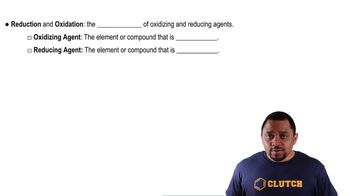
Oxidizing and Reducing Agents

Oxidizing agents are substances that gain electrons in a chemical reaction, causing another substance to be oxidized. Conversely, reducing agents lose electrons, leading to the reduction of another substance. Understanding the roles of these agents is crucial for predicting the direction of redox reactions and determining the feasibility of reactions based on standard electrode potentials.
추천 영상:
가이드 코스
01:01
Oxidizing and Reducing Agents

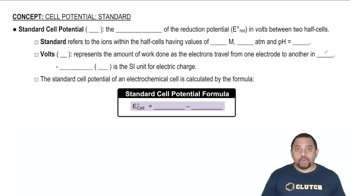
Standard Electrode Potential (E°)

The standard electrode potential (E°) is a measure of the tendency of a chemical species to be reduced, expressed in volts. A higher E° value indicates a stronger oxidizing agent, while a lower E° value suggests a stronger reducing agent. By comparing the E° values of the substances listed, one can classify them as oxidizing or reducing agents based on their relative abilities to gain or lose electrons.
추천 영상:
가이드 코스
01:27
Standard Cell Potential

Half-Reaction Method

The half-reaction method involves breaking down redox reactions into two separate half-reactions: one for oxidation and one for reduction. This approach allows for a clearer understanding of electron transfer and the identification of oxidizing and reducing agents. By analyzing the half-reactions of the substances in the question, one can effectively classify each substance based on its role in the overall reaction.
추천 영상:
가이드 코스
01:49
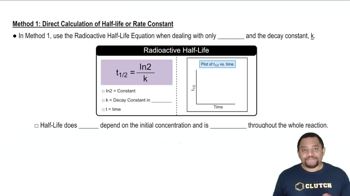
Method 1 of Radioactive Half-Life