Ch.19 - Electrochemistry
McMurry - Chemistry 8th Edition
McMurry8th EditionChemistryISBN: 9781292336145당신이 사용하는 게 아니라요?교과서 변경
19장, 문제 66

What conditions must be met for a cell potential E to qualify as a standard cell potential E°?

검증된 단계별 안내
1
Identify the conditions of the reactants and products: For a cell potential to be considered a standard cell potential (E°), all reactants and products in the electrochemical cell must be in their standard states.
Define standard state conditions: The standard state for a substance is typically defined as its pure form at 1 bar (approximately 1 atmosphere) of pressure and at a specified temperature, usually 25°C (298 K).
Concentration of solutions: All solutions in the electrochemical cell must have a concentration of 1 Molar (1 M).
Gas pressures: Any gases involved in the electrochemical reactions must be at a pressure of 1 bar.
Temperature: The temperature of the cell must be maintained at 25°C (298 K) unless otherwise specified for different standard conditions.

비슷한 문제에 대한 검증된 영상 답변:

이 영상 해법은 위 문제에 도움이 된다고 튜터들이 추천한 것입니다.
영상 길이:
1m
도움이 되었나요?

주요 개념

질문에 올바르게 답하기 위해 반드시 이해해야 하는 핵심 개념들은 다음과 같습니다.

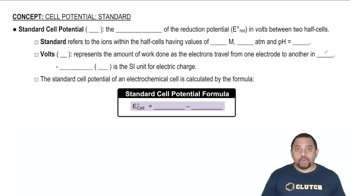
Standard Cell Potential (E°)

The standard cell potential (E°) is the measure of the voltage produced by an electrochemical cell under standard conditions, which include a temperature of 25°C (298 K), a pressure of 1 atm, and reactant concentrations of 1 M. It reflects the tendency of a chemical reaction to occur spontaneously and is a crucial parameter in determining the feasibility of electrochemical processes.
추천 영상:
가이드 코스
01:27
Standard Cell Potential

Standard Conditions

Standard conditions refer to the specific set of parameters under which thermodynamic measurements are made, ensuring consistency and comparability. For electrochemical cells, these conditions include a temperature of 25°C, a pressure of 1 atm, and all solute concentrations at 1 M. Meeting these conditions is essential for accurately determining the standard cell potential.
추천 영상:
가이드 코스
01:10
Standard Reduction Potentials

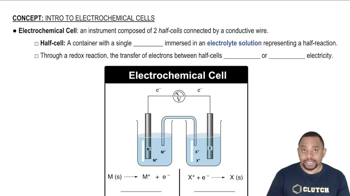
Electrochemical Cell

An electrochemical cell consists of two electrodes (anode and cathode) immersed in an electrolyte, facilitating redox reactions that generate electrical energy. The cell potential (E) is influenced by the nature of the electrodes, the electrolyte, and the concentrations of the reactants and products. Understanding the structure and function of electrochemical cells is vital for analyzing their performance and potential.
추천 영상:
가이드 코스
02:46
Electrochemical Cells