Ch.19 - Electrochemistry
McMurry - Chemistry 8th Edition
McMurry8th EditionChemistryISBN: 9781292336145당신이 사용하는 게 아니라요?교과서 변경
19장, 문제 101b

When suspected drunk drivers are tested with a Breathalyzer, the alcohol (ethanol) in the exhaled breath is oxidized to acetic acid with an acidic solution of potassium dichromate: The color of the solution changes because some of the orange Cr2O72- is converted to the green Cr3+ The Breathalyzer measures the color change and produces a meter reading calibrated in blood alcohol content. (b) What is the value of E for the reaction when the concentrations of ethanol, acetic acid, Cr2O7 are 1.0 M and the pH is 4.00?

검증된 단계별 안내
1
Identify the half-reactions involved in the redox process. Ethanol is oxidized to acetic acid, and dichromate ions are reduced to chromium ions.
Write the balanced half-reactions for the oxidation of ethanol to acetic acid and the reduction of Cr_2O_7^{2-} to Cr^{3+}.
Use the Nernst equation to calculate the cell potential (E) under non-standard conditions: E = E^0 - (RT/nF) * ln(Q), where Q is the reaction quotient.
Determine the standard cell potential (E^0) by using standard reduction potentials from a table for each half-reaction and combining them.
Calculate the reaction quotient (Q) using the given concentrations and pH, and substitute all known values into the Nernst equation to find E.

비슷한 문제에 대한 검증된 영상 답변:

이 영상 해법은 위 문제에 도움이 된다고 튜터들이 추천한 것입니다.
영상 길이:
16m
도움이 되었나요?

주요 개념

질문에 올바르게 답하기 위해 반드시 이해해야 하는 핵심 개념들은 다음과 같습니다.

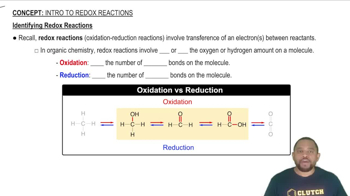
Redox Reactions

Redox reactions involve the transfer of electrons between two species, where one is oxidized (loses electrons) and the other is reduced (gains electrons). In the context of the Breathalyzer, ethanol is oxidized to acetic acid, while potassium dichromate is reduced, leading to a color change in the solution. Understanding the oxidation states of the involved species is crucial for analyzing the reaction.
추천 영상:
가이드 코스
03:12
Identifying Redox Reactions

Electrode Potential (E)

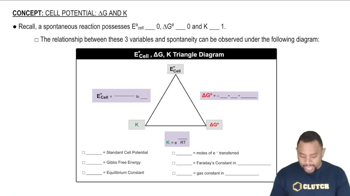
The electrode potential (E) is a measure of the tendency of a chemical species to be reduced, expressed in volts. It is determined under standard conditions but can be adjusted for concentration and pH using the Nernst equation. In this scenario, calculating E for the reaction requires knowledge of the standard reduction potentials and the concentrations of the reactants.
추천 영상:
가이드 코스
02:43
Relationship between ∆E°, ∆G°, and K

Nernst Equation

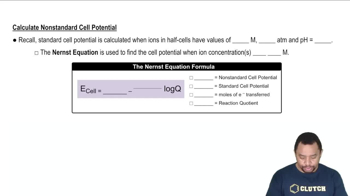
The Nernst equation relates the cell potential to the concentrations of the reactants and products at non-standard conditions. It is given by E = E° - (RT/nF)ln(Q), where E° is the standard potential, R is the gas constant, T is the temperature in Kelvin, n is the number of moles of electrons transferred, F is Faraday's constant, and Q is the reaction quotient. This equation is essential for calculating the actual electrode potential in the Breathalyzer reaction.
추천 영상:
가이드 코스
01:17
The Nernst Equation