Ch.19 - Electrochemistry
McMurry - Chemistry 8th Edition
McMurry8th EditionChemistryISBN: 9781292336145당신이 사용하는 게 아니라요?교과서 변경
19장, 문제 52a

Write balanced net ionic equations for the following reactions in basic solution. (a)

검증된 단계별 안내
1
Identify the reactants and products in the given chemical reaction.
Write the balanced molecular equation for the reaction.
Separate the aqueous compounds into their respective ions to write the complete ionic equation.
Identify and cancel out the spectator ions to derive the net ionic equation.
Ensure the net ionic equation is balanced for both mass and charge, and adjust for basic conditions by adding OH⁻ ions if necessary.

비슷한 문제에 대한 검증된 영상 답변:

이 영상 해법은 위 문제에 도움이 된다고 튜터들이 추천한 것입니다.
영상 길이:
8m
도움이 되었나요?

주요 개념

질문에 올바르게 답하기 위해 반드시 이해해야 하는 핵심 개념들은 다음과 같습니다.

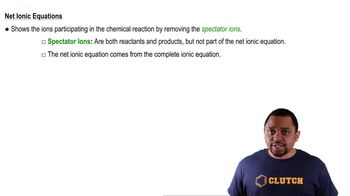
Net Ionic Equations

Net ionic equations represent the actual chemical species that participate in a reaction, excluding spectator ions. They are derived from complete ionic equations by removing ions that do not change during the reaction. This simplification helps to focus on the essential components and the changes occurring in the reaction.
추천 영상:
가이드 코스
00:51
Net Ionic Equations

Basic Solution

A basic solution has a pH greater than 7 and contains hydroxide ions (OH-). In reactions occurring in basic conditions, the presence of OH- can influence the formation of products and the overall reaction mechanism. Understanding how to manipulate hydroxide ions is crucial for balancing equations in such environments.
추천 영상:
가이드 코스
01:04
Balancing Basic Redox Reactions

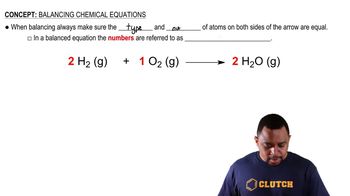
Balancing Chemical Equations

Balancing chemical equations involves ensuring that the number of atoms for each element is the same on both sides of the equation. This is essential for obeying the law of conservation of mass. In the context of net ionic equations, balancing also includes accounting for charge, ensuring that the total charge is equal on both sides.
추천 영상:
가이드 코스
01:32
Balancing Chemical Equations