Ch.2 - Atoms, Molecules & Ions
McMurry - Chemistry 8th Edition
McMurry8th EditionChemistryISBN: 9781292336145당신이 사용하는 게 아니라요?교과서 변경
2장, 문제 76

How does Dalton's atomic theory account for the law of mass conservation and the law of definite proportions?

검증된 단계별 안내
1
Understand Dalton's atomic theory: Dalton proposed that all matter is made up of indivisible and indestructible atoms. Each element consists of only one type of atom, and atoms of different elements can combine in fixed ratios to form compounds.
Relate to the law of mass conservation: According to the law of mass conservation, mass is neither created nor destroyed in a chemical reaction. Dalton's theory supports this by suggesting that atoms are merely rearranged in reactions, not created or destroyed, thus conserving the total mass.
Examine the law of definite proportions: This law states that a chemical compound always contains its component elements in fixed ratio by mass and does not depend on its source or how it was prepared. Dalton's theory explains this by proposing that compounds are formed from atoms of the constituent elements combining in simple whole-number ratios, maintaining consistent mass ratios.
Consider the implications of indivisible atoms: Since atoms are indivisible in chemical processes according to Dalton, the same number of each type of atom must be present in both the reactants and products of a reaction, ensuring that the mass remains constant.
Apply Dalton's theory to chemical reactions: In any chemical reaction, the rearrangement of atoms into new combinations or configurations adheres to the laws of mass conservation and definite proportions, as the total number and type of atoms (and thus the total mass) remain constant throughout the reaction.

비슷한 문제에 대한 검증된 영상 답변:

이 영상 해법은 위 문제에 도움이 된다고 튜터들이 추천한 것입니다.
영상 길이:
1m

주요 개념

질문에 올바르게 답하기 위해 반드시 이해해야 하는 핵심 개념들은 다음과 같습니다.

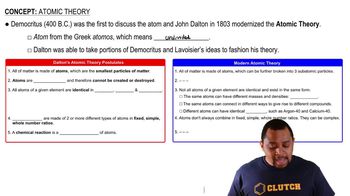
Dalton's Atomic Theory

Dalton's atomic theory posits that matter is composed of indivisible atoms, which are the fundamental building blocks of all substances. Each element consists of identical atoms that differ from those of other elements. This theory laid the groundwork for understanding chemical reactions as rearrangements of atoms, rather than changes in the atoms themselves.
추천 영상:
가이드 코스
05:22
Dalton's Atomic Theory

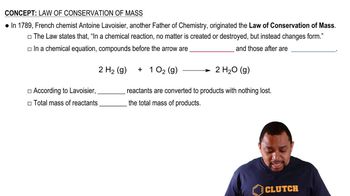
Law of Mass Conservation

The law of mass conservation states that mass is neither created nor destroyed in a chemical reaction. This principle implies that the total mass of reactants must equal the total mass of products. Dalton's atomic theory supports this law by asserting that atoms are simply rearranged during reactions, ensuring that the same number of atoms (and thus mass) is present before and after the reaction.
추천 영상:
가이드 코스
01:48
Law of Conservation of Mass

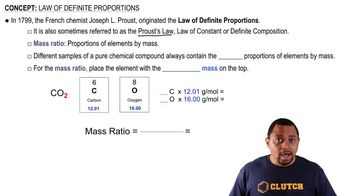
Law of Definite Proportions

The law of definite proportions states that a chemical compound always contains its component elements in fixed ratio by mass, regardless of the sample size or source. Dalton's atomic theory explains this by suggesting that compounds are formed from specific combinations of atoms in defined ratios, which leads to consistent proportions of elements in any given compound.
추천 영상:
가이드 코스
02:48
Law of Definite Proportions