Ch.2 - Atoms, Molecules & Ions
McMurry - Chemistry 8th Edition
McMurry8th EditionChemistryISBN: 9781292336145당신이 사용하는 게 아니라요?교과서 변경
2장, 문제 104d

How many protons, neutrons, and electrons are in each of the following atoms? (d)

검증된 단계별 안내
1
Step 1: Identify the atomic number (Z) and the atomic mass number (A) of the atom. The atomic number is the number of protons in the nucleus of an atom, and it is unique to each element. The atomic mass number is the total number of protons and neutrons in the nucleus.
Step 2: Determine the number of protons in the atom. The number of protons is equal to the atomic number (Z).
Step 3: Determine the number of neutrons in the atom. The number of neutrons is equal to the atomic mass number (A) minus the atomic number (Z).
Step 4: Determine the number of electrons in the atom. In a neutral atom, the number of electrons is equal to the number of protons. If the atom is an ion, the number of electrons will be the number of protons plus or minus the charge of the ion.
Step 5: Summarize your findings. State the number of protons, neutrons, and electrons in the atom.

비슷한 문제에 대한 검증된 영상 답변:

이 영상 해법은 위 문제에 도움이 된다고 튜터들이 추천한 것입니다.
영상 길이:
2m

주요 개념

질문에 올바르게 답하기 위해 반드시 이해해야 하는 핵심 개념들은 다음과 같습니다.

Atomic Structure

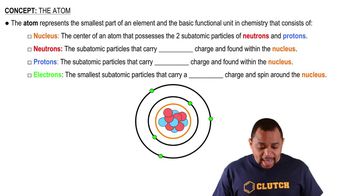
Atoms are the basic units of matter, consisting of protons, neutrons, and electrons. Protons are positively charged particles found in the nucleus, neutrons are neutral particles also located in the nucleus, and electrons are negatively charged particles that orbit the nucleus. The number of protons defines the element, while the total number of protons and neutrons gives the atomic mass.
추천 영상:

Atomic Number and Mass Number

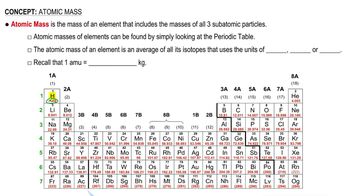
The atomic number of an element is the number of protons in its nucleus, which determines the element's identity. The mass number is the sum of protons and neutrons in the nucleus. For example, an atom with 6 protons and 6 neutrons has an atomic number of 6 (carbon) and a mass number of 12.
추천 영상:

Charge Balance in Atoms

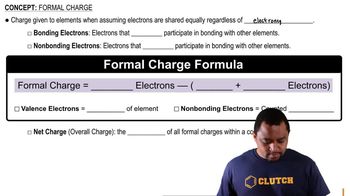
In a neutral atom, the number of electrons equals the number of protons, balancing the overall charge. If an atom gains or loses electrons, it becomes an ion, which can be positively charged (cation) or negatively charged (anion). Understanding this balance is crucial for determining the electron count in various atomic species.
추천 영상: