Ch.2 - Atoms, Molecules & Ions
McMurry - Chemistry 8th Edition
McMurry8th EditionChemistryISBN: 9781292336145당신이 사용하는 게 아니라요?교과서 변경
2장, 문제 111

Hydrogen has three isotopes (1H, 2H, and 3H), and chlorine has two isotopes (35Cl and 37Cl). How many isotopic kinds of HCl are there? Write the formula for each, and state how many protons, neutrons, and electrons each contains.

검증된 단계별 안내
1
Identify the isotopes of hydrogen and chlorine: Hydrogen has three isotopes (\(^1\text{H}\), \(^2\text{H}\), \(^3\text{H}\)) and chlorine has two isotopes (\(^{35}\text{Cl}\), \(^{37}\text{Cl}\)).
Determine the possible combinations of hydrogen and chlorine isotopes to form HCl: Each hydrogen isotope can pair with each chlorine isotope, resulting in different isotopic kinds of HCl.
Calculate the number of isotopic kinds of HCl: Multiply the number of hydrogen isotopes (3) by the number of chlorine isotopes (2) to find the total number of isotopic combinations.
List the formula for each isotopic kind of HCl: \(^1\text{H}^{35}\text{Cl}\), \(^1\text{H}^{37}\text{Cl}\), \(^2\text{H}^{35}\text{Cl}\), \(^2\text{H}^{37}\text{Cl}\), \(^3\text{H}^{35}\text{Cl}\), \(^3\text{H}^{37}\text{Cl}\).
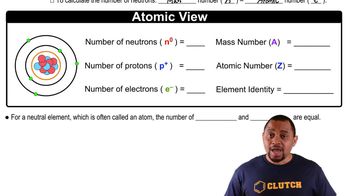
For each isotopic kind, determine the number of protons, neutrons, and electrons: Use the atomic number for protons and electrons, and subtract the atomic number from the mass number to find the number of neutrons.

주요 개념

질문에 올바르게 답하기 위해 반드시 이해해야 하는 핵심 개념들은 다음과 같습니다.

Isotopes

Isotopes are variants of a chemical element that have the same number of protons but different numbers of neutrons. This results in different atomic masses for the isotopes. For example, hydrogen has three isotopes: protium (1H), deuterium (2H), and tritium (3H), each differing in neutron count.
추천 영상:

Molecular Composition

The molecular composition of a compound is determined by the types and numbers of atoms it contains. In the case of HCl, the molecule consists of one hydrogen atom and one chlorine atom. The isotopes of hydrogen will combine with the isotopes of chlorine to form different isotopic versions of HCl.
추천 영상:
가이드 코스
04:19
Matter Composition

Subatomic Particles

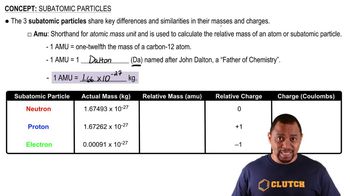
Atoms are composed of protons, neutrons, and electrons. Protons are positively charged and found in the nucleus, neutrons are neutral and also in the nucleus, while electrons are negatively charged and orbit the nucleus. The number of these particles varies with isotopes, affecting the atomic mass but not the chemical behavior.
추천 영상:
가이드 코스
05:19
Subatomic Particles