Ch.2 - Atoms, Molecules & Ions
McMurry - Chemistry 8th Edition
McMurry8th EditionChemistryISBN: 9781292336145당신이 사용하는 게 아니라요?교과서 변경
2장, 문제 40

In the following drawings, red spheres represent protons, and blue spheres represent neutrons. Which of the draw-ings represent different isotopes of the same element, and which represents a different element altogether? (a) Three diagrams showing atomic structures with red protons and blue neutrons, illustrating isotopes.
(b)
(c)

검증된 단계별 안내
1
Identify the number of protons (red spheres) and neutrons (blue spheres) in each drawing.
Compare the number of protons in each drawing to determine if they represent the same element. Elements are defined by their number of protons.
Compare the number of neutrons in each drawing to determine if they are isotopes of the same element. Isotopes have the same number of protons but different numbers of neutrons.
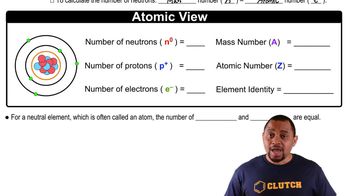
Drawing (i) has 3 protons and 3 neutrons.
Drawing (ii) has 3 protons and 4 neutrons, and Drawing (iii) has 2 protons and 3 neutrons.

비슷한 문제에 대한 검증된 영상 답변:

이 영상 해법은 위 문제에 도움이 된다고 튜터들이 추천한 것입니다.
영상 길이:
2m
도움이 되었나요?

주요 개념

질문에 올바르게 답하기 위해 반드시 이해해야 하는 핵심 개념들은 다음과 같습니다.

Isotopes

Isotopes are variants of a particular chemical element that have the same number of protons but different numbers of neutrons. This difference in neutron count results in varying atomic masses. For example, carbon-12 and carbon-14 are isotopes of carbon, where carbon-12 has six neutrons and carbon-14 has eight. Understanding isotopes is crucial for identifying elements and their properties.
추천 영상:

Atomic Structure

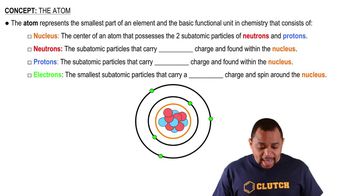
The atomic structure consists of protons, neutrons, and electrons, with protons and neutrons located in the nucleus and electrons orbiting around it. The number of protons defines the element, while the arrangement of neutrons and electrons influences its chemical behavior. Recognizing how these particles interact helps in distinguishing between different elements and isotopes.
추천 영상:

Element Identification

Elements are identified by their atomic number, which is the number of protons in the nucleus. Different elements have unique atomic numbers, and thus, a change in the number of protons signifies a different element. In the context of isotopes, while the number of protons remains constant, variations in neutrons can lead to different isotopes of the same element, highlighting the importance of understanding atomic composition.
추천 영상:
가이드 코스
01:15
Chalcogen Identification Example