
Ch.2 - Atoms, Molecules & Ions
McMurry - Chemistry 8th Edition
McMurry8th EditionChemistryISBN: 9781292336145당신이 사용하는 게 아니라요?교과서 변경
2장, 문제 83

The atomic weight of carbon (12.011) is approximately 12 times that of hydrogen (1.008). (a) Show how you can use this knowledge to calculate pos-sible formulas for benzene, ethane, and ethylene (Prob-lem 2.82).

검증된 단계별 안내
1
Identify the molecular formulas for benzene, ethane, and ethylene: Benzene (C6H6), Ethane (C2H6), Ethylene (C2H4).
Calculate the molar mass of each compound using the atomic weights: For benzene, multiply the number of carbon atoms by the atomic weight of carbon and the number of hydrogen atoms by the atomic weight of hydrogen, then sum these values.
Repeat the calculation for ethane: Multiply the number of carbon atoms by the atomic weight of carbon and the number of hydrogen atoms by the atomic weight of hydrogen, then sum these values.
Repeat the calculation for ethylene: Multiply the number of carbon atoms by the atomic weight of carbon and the number of hydrogen atoms by the atomic weight of hydrogen, then sum these values.
Compare the calculated molar masses with the known atomic weights to verify the possible formulas for benzene, ethane, and ethylene.

비슷한 문제에 대한 검증된 영상 답변:

이 영상 해법은 위 문제에 도움이 된다고 튜터들이 추천한 것입니다.
영상 길이:
15m

주요 개념

질문에 올바르게 답하기 위해 반드시 이해해야 하는 핵심 개념들은 다음과 같습니다.

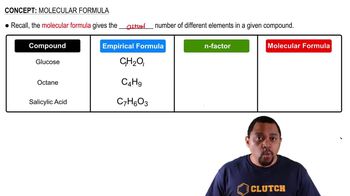
Molecular Formula

A molecular formula represents the number and type of atoms in a molecule. For hydrocarbons like benzene, ethane, and ethylene, the formula indicates the ratio of carbon (C) to hydrogen (H) atoms. Understanding how to derive these formulas based on atomic weights and the number of atoms is essential for calculating possible molecular structures.
추천 영상:
가이드 코스
02:08
Determining Molecular Formulas

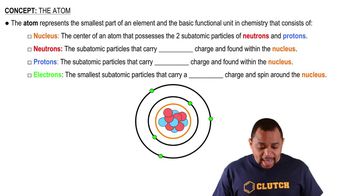
Atomic Weight

Atomic weight is the weighted average mass of an element's isotopes, measured in atomic mass units (amu). For carbon, the atomic weight is approximately 12.011 amu, while for hydrogen, it is about 1.008 amu. This concept is crucial for determining the mass contributions of each element in a compound, which aids in calculating molecular formulas.
추천 영상:

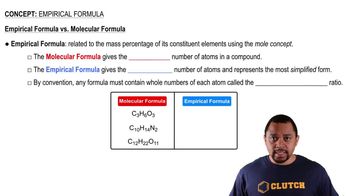
Empirical vs. Molecular Formula

The empirical formula represents the simplest whole-number ratio of atoms in a compound, while the molecular formula shows the actual number of atoms. For example, benzene has a molecular formula of C6H6, but its empirical formula is CH. Understanding the distinction between these formulas is important for accurately determining the composition of organic compounds based on their atomic weights.
추천 영상:
가이드 코스
02:26
Empirical vs Molecular Formula