Ch.2 - Atoms, Molecules & Ions
McMurry - Chemistry 8th Edition
McMurry8th EditionChemistryISBN: 9781292336145당신이 사용하는 게 아니라요?교과서 변경
2장, 문제 60

Where in the periodic table are the metallic elements found? Where are the nonmetallic elements found?Color-coded periodic table highlighting metallic and nonmetallic elements.

검증된 단계별 안내
1
Observe the periodic table image provided, which is color-coded to distinguish between metallic and nonmetallic elements.
Note that the elements colored in blue represent the metallic elements.
Notice that the elements colored in red represent the nonmetallic elements.
Identify that the elements colored in green represent the metalloids, which have properties intermediate between metals and nonmetals.
Conclude that metallic elements are primarily found on the left side and in the center of the periodic table, while nonmetallic elements are found on the right side of the periodic table.

비슷한 문제에 대한 검증된 영상 답변:

이 영상 해법은 위 문제에 도움이 된다고 튜터들이 추천한 것입니다.
영상 길이:
1m
도움이 되었나요?

주요 개념

질문에 올바르게 답하기 위해 반드시 이해해야 하는 핵심 개념들은 다음과 같습니다.

Metallic Elements

Metallic elements are primarily found on the left side and in the center of the periodic table. They are characterized by their ability to conduct electricity and heat, malleability, ductility, and a shiny appearance. Common examples include iron, copper, and gold. The majority of elements in the periodic table are metals.
추천 영상:
가이드 코스
03:30
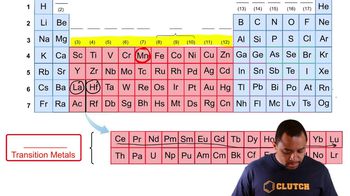
Transition Metals and Representative Elements

Nonmetallic Elements

Nonmetallic elements are located on the right side of the periodic table, with the exception of hydrogen, which is positioned at the top left. These elements are generally poor conductors of heat and electricity and can be gases, liquids, or solids at room temperature. Examples include oxygen, nitrogen, and sulfur. Nonmetals tend to gain electrons during chemical reactions.
추천 영상:
가이드 코스
02:35
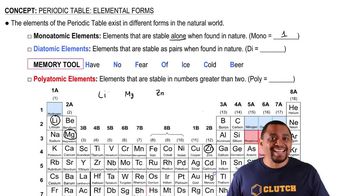
Elemental Forms of Elements

Periodic Table Structure

The periodic table is organized in a way that groups elements with similar properties together. Rows, known as periods, indicate the number of electron shells, while columns, called groups, reflect the number of valence electrons. This structure helps predict the behavior of elements, including their metallic or nonmetallic characteristics, based on their position in the table.
추천 영상:
가이드 코스
02:40
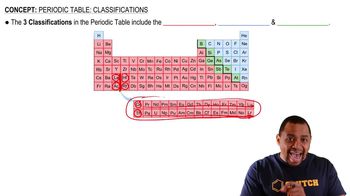
Periodic Table Classifications