Ch.2 - Atoms, Molecules & Ions
McMurry - Chemistry 8th Edition
McMurry8th EditionChemistryISBN: 9781292336145당신이 사용하는 게 아니라요?교과서 변경
2장, 문제 103

Write symbols for the following isotopes: (a) Z = 58 and A = 140 (b) Z = 27 and A = 60

검증된 단계별 안내
1
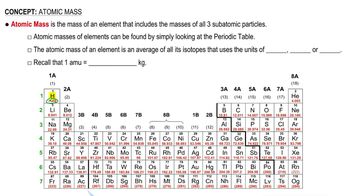
Identify the element using the atomic number (Z). For (a), Z = 58 corresponds to the element Cerium (Ce) on the periodic table.
Write the isotope notation for Cerium with the given mass number (A = 140). The notation is written as \( ^{140}_{58}Ce \).
Identify the element using the atomic number (Z). For (b), Z = 27 corresponds to the element Cobalt (Co) on the periodic table.
Write the isotope notation for Cobalt with the given mass number (A = 60). The notation is written as \( ^{60}_{27}Co \).
Review the isotope notation: The superscript (A) is the mass number, and the subscript (Z) is the atomic number, followed by the element symbol.

비슷한 문제에 대한 검증된 영상 답변:

이 영상 해법은 위 문제에 도움이 된다고 튜터들이 추천한 것입니다.
영상 길이:
2m

주요 개념

질문에 올바르게 답하기 위해 반드시 이해해야 하는 핵심 개념들은 다음과 같습니다.

Isotopes

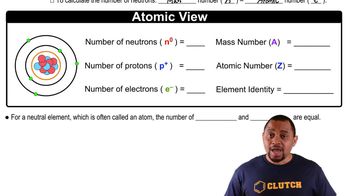
Isotopes are variants of a particular chemical element that have the same number of protons (atomic number, Z) but different numbers of neutrons, resulting in different mass numbers (A). For example, carbon-12 and carbon-14 are isotopes of carbon, with 6 and 8 neutrons, respectively.
추천 영상:

Atomic Number (Z)

The atomic number (Z) is the number of protons in the nucleus of an atom, which defines the element and its position in the periodic table. It determines the chemical properties of the element and its identity; for instance, an element with Z = 27 is cobalt.
추천 영상:

Mass Number (A)

The mass number (A) is the total number of protons and neutrons in an atom's nucleus. It is used to distinguish between different isotopes of the same element. For example, if an element has Z = 27 and A = 60, it has 27 protons and 33 neutrons (60 - 27 = 33).
추천 영상: