
Ch.20 - Nuclear Chemistry
McMurry - Chemistry 8th Edition
McMurry8th EditionChemistryISBN: 9781292336145당신이 사용하는 게 아니라요?교과서 변경
20장, 문제 7

Calculate the binding energy a uranium-235 nucleus in units of MeV/nucleon. The mass of an 235U atom is 235.043 929, the mass of a proton is 1.007 28, the mass of a neutron is 1.008 67, and the mass of an electron is 5.486 x 10^-4. (1 MeV = 1.60 x 10^-13 J) (a) 2.84 MeV/nucleon (b) 1.70 x 10^3 MeV/nucleon (c) 11.3 MeV/nucleon (d) 7.62 MeV/nucleon

검증된 단계별 안내
1
Calculate the number of protons (Z) and neutrons (N) in the uranium-235 nucleus. Uranium-235 has 92 protons, so the number of neutrons is 235 - 92 = 143.
Calculate the total mass of the protons and neutrons if they were free particles: Total mass = (Z * mass of proton) + (N * mass of neutron).
Calculate the mass defect (Δm) by subtracting the actual mass of the uranium-235 nucleus from the total mass of the protons and neutrons: Δm = (Total mass of protons and neutrons) - (mass of 235U atom).
Convert the mass defect from atomic mass units (amu) to energy using Einstein's equation, E = Δm * c^2, where c is the speed of light. Note that 1 amu = 931.5 MeV/c^2.
Calculate the binding energy per nucleon by dividing the total binding energy by the number of nucleons (A = 235) in the uranium-235 nucleus.

비슷한 문제에 대한 검증된 영상 답변:

이 영상 해법은 위 문제에 도움이 된다고 튜터들이 추천한 것입니다.
영상 길이:
8m

주요 개념

질문에 올바르게 답하기 위해 반드시 이해해야 하는 핵심 개념들은 다음과 같습니다.

Binding Energy

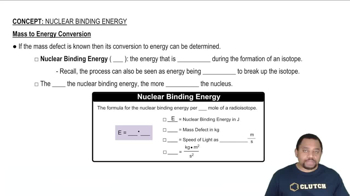
Binding energy is the energy required to disassemble a nucleus into its constituent protons and neutrons. It reflects the stability of the nucleus; a higher binding energy indicates a more stable nucleus. This energy can be calculated using the mass defect, which is the difference between the mass of the individual nucleons and the actual mass of the nucleus.
추천 영상:
가이드 코스
02:06
Nuclear Binding Energy

Mass Defect

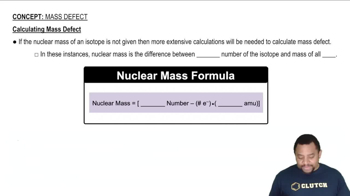
The mass defect is the difference between the total mass of the separate nucleons (protons and neutrons) and the mass of the nucleus itself. This mass loss, due to the conversion of mass into energy according to Einstein's equation E=mc², is crucial for calculating the binding energy. It highlights how energy is released when nucleons bind together to form a nucleus.
추천 영상:
가이드 코스
00:55
Calculating Mass Defect

Energy Conversion

In nuclear physics, energy is often expressed in different units, such as joules and MeV (mega-electronvolts). To convert the binding energy from joules to MeV, one must use the conversion factor where 1 MeV equals 1.60 x 10^-13 joules. Understanding this conversion is essential for accurately reporting binding energy in the context of nuclear reactions and stability.
추천 영상:
가이드 코스
01:56
Conversion Factors
관련 실천
교과서 질문
In a cave in Oregon, archaeologists found bones, plant remains, and fossilized feces. DNA remaining in the feces indi-cates their human origin but not their age. To date the remains, the decay rate was measured and found to be 2.71 disinte-grations/min per gram of carbon. Currently living organisms have a decay rate of 15.3 disintegrations/min per gram of carbon, and the half-life of 14C is 5715 years. How old are the remains? (a) 1460 years (b) 9900 years (c) 14300 years (d) 18600 years
319
views
교과서 질문
Fluorine-18 undergoes positron emission with a half-life of 1.10 x 10^2 minutes. If a patient is given a 250 mg dose for a PET scan, how long will it take for the amount of fluorine-18 to drop to 75 mg? (a) 56 minutes (b) 96 minutes (c) 132 minutes (d) 191 minutes
786
views
교과서 질문
Identify the true statement about nuclear power plants and nuclear weapons. (a) Nuclear power plants and nuclear weapons both use uranium enriched to about 90% U-235. (b) Nuclear power plants emit large amounts of CO2 just like coal burning power plants. (c) The United States produces less than 1% of its electrical power from nuclear energy. (d) A nuclear weapon explodes when two pieces of fission-able uranium-235 are pushed together to reach a critical mass.
396
views
교과서 질문
How much energy in kJ/mol is released by the fission of uranium-235 to form barium-140 and krypton-93? The atomic masses are (a) 6.59 x 10^9 kJ/mol (b) 1.66 x 10^10 kJ/mol (c) 1.98 x 10^11 kJ/mol (d) 1.66 x 10^16 kJ/mol
559
views