Ch.20 - Nuclear Chemistry
McMurry - Chemistry 8th Edition
McMurry8th EditionChemistryISBN: 9781292336145당신이 사용하는 게 아니라요?교과서 변경
20장, 문제 79

Calculate the mass defect (in g/mol) and the binding energy (in MeV/nucleon) for the following nuclei. Which of the two is more stable? (a) 7Li (atomic mass = 7.016004) (b) 39K (atomic mass = 38.963706)

검증된 단계별 안내
1
Step 1: The mass defect is the difference between the mass of the nucleus and the sum of the masses of its individual protons and neutrons. To calculate the mass defect, you first need to calculate the mass of the protons and neutrons in the nucleus. For 7Li, there are 3 neutrons and 4 protons. For 39K, there are 20 neutrons and 19 protons. The mass of a proton is approximately 1.007825 g/mol and the mass of a neutron is approximately 1.008665 g/mol.
Step 2: Calculate the total mass of the protons and neutrons for each nucleus. For 7Li, multiply the number of protons (4) by the mass of a proton and the number of neutrons (3) by the mass of a neutron, then add these two values together. Do the same for 39K, but with 19 protons and 20 neutrons.
Step 3: Subtract the actual mass of the nucleus (given in the problem) from the total mass of the protons and neutrons (calculated in step 2). This will give you the mass defect for each nucleus.
Step 4: To calculate the binding energy, you need to convert the mass defect from g/mol to kg/mol (by multiplying by 1e-3), then use Einstein's equation E=mc^2, where E is the energy, m is the mass, and c is the speed of light (approximately 3.00e8 m/s). This will give you the total binding energy in joules. To convert this to MeV, divide by 1.602e-13.
Step 5: To find the binding energy per nucleon, divide the total binding energy by the number of nucleons (protons + neutrons). The nucleus with the higher binding energy per nucleon is more stable.

비슷한 문제에 대한 검증된 영상 답변:

이 영상 해법은 위 문제에 도움이 된다고 튜터들이 추천한 것입니다.
영상 길이:
19m

주요 개념

질문에 올바르게 답하기 위해 반드시 이해해야 하는 핵심 개념들은 다음과 같습니다.

Mass Defect

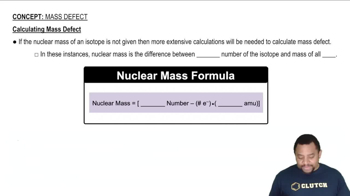
The mass defect is the difference between the mass of an atomic nucleus and the sum of the individual masses of its protons and neutrons. This discrepancy arises because some mass is converted into energy during the formation of the nucleus, according to Einstein's equation E=mc². The mass defect is crucial for understanding nuclear stability and is typically expressed in atomic mass units (u) or grams per mole (g/mol).
추천 영상:
가이드 코스
00:55
Calculating Mass Defect

Binding Energy

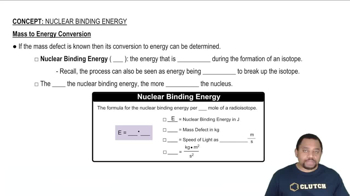
Binding energy is the energy required to disassemble a nucleus into its constituent protons and neutrons. It is directly related to the mass defect, as the energy equivalent of the mass defect represents the binding energy of the nucleus. Binding energy is often expressed in mega-electronvolts per nucleon (MeV/nucleon), providing insight into the stability of the nucleus; a higher binding energy indicates a more stable nucleus.
추천 영상:
가이드 코스
02:06
Nuclear Binding Energy

Nuclear Stability

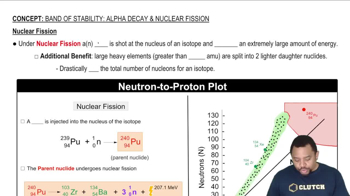
Nuclear stability refers to the ability of a nucleus to remain intact without undergoing radioactive decay. It is influenced by the balance between the attractive nuclear force, which holds protons and neutrons together, and the repulsive electromagnetic force between protons. Nuclei with higher binding energies per nucleon are generally more stable, as they are less likely to break apart, making the comparison of binding energies essential for assessing stability.
추천 영상:
가이드 코스
03:29
Band of Stability: Nuclear Fission