Ch.20 - Nuclear Chemistry
McMurry - Chemistry 8th Edition
McMurry8th EditionChemistryISBN: 9781292336145당신이 사용하는 게 아니라요?교과서 변경
20장, 문제 31a

Complete and balance the following nuclear equations. (a)

검증된 단계별 안내
1
Identify the type of nuclear reaction involved (e.g., alpha decay, beta decay, positron emission, electron capture, etc.).
Write down the known parts of the nuclear equation, including the reactants and any given products.
Use the conservation of mass number and atomic number to determine the missing particles or nuclei. The sum of mass numbers (top numbers) and atomic numbers (bottom numbers) must be equal on both sides of the equation.
Identify the missing particle or nucleus by comparing the mass numbers and atomic numbers on both sides of the equation. Common particles include alpha particles (\( ^4_2\text{He} \)), beta particles (\( ^0_{-1}\beta \)), positrons (\( ^0_{+1}\beta \)), and neutrons (\( ^1_0\text{n} \)).
Write the complete and balanced nuclear equation, ensuring that both the mass numbers and atomic numbers are balanced.

비슷한 문제에 대한 검증된 영상 답변:

이 영상 해법은 위 문제에 도움이 된다고 튜터들이 추천한 것입니다.
영상 길이:
2m
도움이 되었나요?

주요 개념

질문에 올바르게 답하기 위해 반드시 이해해야 하는 핵심 개념들은 다음과 같습니다.

Nuclear Reactions

Nuclear reactions involve changes in an atom's nucleus and can result in the transformation of one element into another. These reactions include processes such as alpha decay, beta decay, and nuclear fission. Understanding the type of nuclear reaction is crucial for balancing nuclear equations, as it dictates the particles involved and the resulting products.
추천 영상:
가이드 코스
02:06
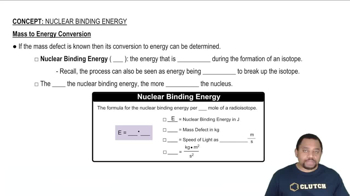
Nuclear Binding Energy

Conservation of Mass and Charge

In nuclear equations, both mass and charge must be conserved. This means that the total mass number (sum of protons and neutrons) and the total charge (sum of positive and negative charges) on both sides of the equation must be equal. This principle is essential for correctly balancing nuclear equations, ensuring that the number of nucleons and the charge are accounted for.
추천 영상:
가이드 코스
01:48
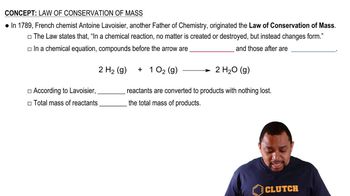
Law of Conservation of Mass

Notation of Nuclear Particles

Nuclear particles are represented using specific notation, where elements are denoted by their chemical symbols, and their mass and atomic numbers are indicated as superscripts and subscripts, respectively. For example, an alpha particle is represented as 4He2. Familiarity with this notation is necessary for accurately writing and balancing nuclear equations, as it helps identify the particles involved in the reaction.
추천 영상:
가이드 코스
02:50
Standard Notation to Scientific Notation