Ch.20 - Nuclear Chemistry
McMurry - Chemistry 8th Edition
McMurry8th EditionChemistryISBN: 9781292336145당신이 사용하는 게 아니라요?교과서 변경
20장, 문제 104

One of the new superheavy elements added to the periodic table in 2016 was synthesized when a beam of 48Ca ions was directed at a target of 249Cf. (a) Write a balanced nuclear equation for the formation of this element. (b) What isotope is formed after the nuclide formed in the nuclear transmutation reaction in part (a) emits four alpha particles?

검증된 단계별 안내
1
Step 1: Identify the reactants and products in the nuclear reaction. The reactants are 48Ca (Calcium-48) and 249Cf (Californium-249). The product is a new superheavy element, which we can denote as element X with a mass number A and atomic number Z.
Step 2: Write the nuclear equation for the synthesis of the new element. The equation is: \[ ^{48}_{20}\text{Ca} + ^{249}_{98}\text{Cf} \rightarrow ^{A}_{Z}\text{X} + ^{1}_{0}\text{n} \] where a neutron is also produced.
Step 3: Balance the nuclear equation by ensuring the sum of atomic numbers and mass numbers on both sides are equal. Calculate A and Z for the new element X using the conservation of mass and atomic numbers.
Step 4: Determine the isotope formed after the emission of four alpha particles. An alpha particle is \( ^{4}_{2}\text{He} \), so emitting four alpha particles will decrease the mass number by 16 and the atomic number by 8.
Step 5: Write the nuclear equation for the decay of the new element by emitting four alpha particles. The equation is: \[ ^{A}_{Z}\text{X} \rightarrow ^{(A-16)}_{(Z-8)}\text{Y} + 4(^{4}_{2}\text{He}) \] where Y is the resulting isotope.

주요 개념

질문에 올바르게 답하기 위해 반드시 이해해야 하는 핵심 개념들은 다음과 같습니다.

Nuclear Reactions

Nuclear reactions involve changes in an atom's nucleus and can result in the formation of new elements. In the context of the question, a nuclear reaction occurs when calcium ions collide with californium, leading to the synthesis of a superheavy element. Understanding how to balance nuclear equations is crucial, as it ensures that the number of protons and neutrons is conserved during the reaction.
추천 영상:
가이드 코스
02:06
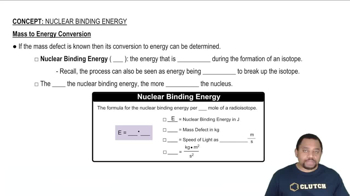
Nuclear Binding Energy

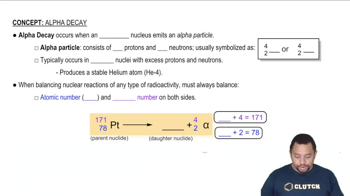
Alpha Decay

Alpha decay is a type of radioactive decay in which an unstable nucleus emits an alpha particle, consisting of two protons and two neutrons. This process decreases the atomic number by two and the mass number by four, resulting in the formation of a new isotope. Recognizing how alpha decay affects the identity and stability of isotopes is essential for predicting the products of nuclear transmutation.
추천 영상:

Isotopes

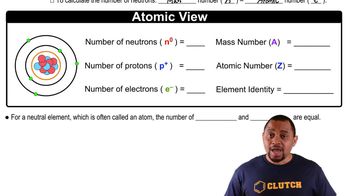
Isotopes are variants of a chemical element that have the same number of protons but different numbers of neutrons, leading to different mass numbers. The question requires identifying the isotope formed after a series of alpha emissions, which involves calculating the changes in atomic and mass numbers. Understanding isotopes is fundamental in nuclear chemistry, particularly in the context of decay processes and their applications.
추천 영상: