
Ch.20 - Nuclear Chemistry
McMurry - Chemistry 8th Edition
McMurry8th EditionChemistryISBN: 9781292336145당신이 사용하는 게 아니라요?교과서 변경
20장, 문제 70

Uranium-238 has a half-life of 4.47 * 109 years and decays through a series of events to yield lead-206. Estimate the age of a rock that contains 105 mmol of 238U and 33 mmol of 206Pb. Assume all the 206Pb is from the decay of 238U.

검증된 단계별 안내
1
Determine the initial amount of 238U. Since all the 206Pb is from the decay of 238U, the initial amount of 238U would be the sum of the current amounts of 238U and 206Pb.
Calculate the ratio of remaining 238U to the initial amount of 238U. This is done by dividing the current amount of 238U by the initial amount calculated in the first step.
Use the half-life formula to relate the ratio calculated in step 2 to the number of half-lives that have passed. The formula is: \( N = N_0 \times (\frac{1}{2})^{t/T} \), where \( N \) is the remaining amount, \( N_0 \) is the initial amount, \( t \) is the time elapsed, and \( T \) is the half-life.
Solve the equation from step 3 for \( t \), the time elapsed, which represents the age of the rock. Rearrange the formula to isolate \( t \): \( t = T \times \frac{\log(N/N_0)}{\log(1/2)} \).
Substitute the values for \( N \), \( N_0 \), and \( T \) into the rearranged formula to calculate the age of the rock.

비슷한 문제에 대한 검증된 영상 답변:

이 영상 해법은 위 문제에 도움이 된다고 튜터들이 추천한 것입니다.
영상 길이:
5m

주요 개념

질문에 올바르게 답하기 위해 반드시 이해해야 하는 핵심 개념들은 다음과 같습니다.

Half-life

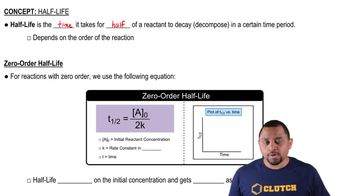
Half-life is the time required for half of the radioactive nuclei in a sample to decay. For Uranium-238, this period is approximately 4.47 billion years. Understanding half-life is crucial for estimating the age of geological samples, as it allows us to calculate how many half-lives have passed based on the ratio of parent isotopes (U-238) to daughter isotopes (Pb-206).
추천 영상:
가이드 코스
02:17
Zero-Order Half-life

Radioactive decay

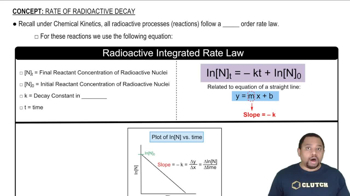
Radioactive decay is the process by which unstable atomic nuclei lose energy by emitting radiation, resulting in the transformation of the original element into a different element or isotope. In this case, Uranium-238 decays into Lead-206 through a series of intermediate isotopes. This concept is essential for understanding how the initial amount of U-238 relates to the amount of Pb-206 present in the rock sample.
추천 영상:
가이드 코스
03:00
Rate of Radioactive Decay

Isotope ratio

The isotope ratio compares the quantities of different isotopes of an element in a sample. In this scenario, the ratio of Uranium-238 to Lead-206 is used to determine the age of the rock. By knowing the initial amount of U-238 and the amount of Pb-206 produced from its decay, we can apply the half-life to calculate how long the decay process has been occurring, thus estimating the rock's age.
추천 영상:
가이드 코스
02:14
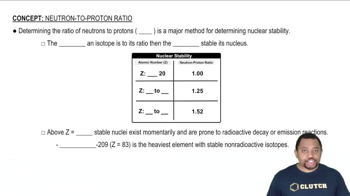
Neutron-Proton Ratio