Why does beta emission raise the atomic number of the product while positron emission lowers. the atomic number?
검증된 단계별 안내
1
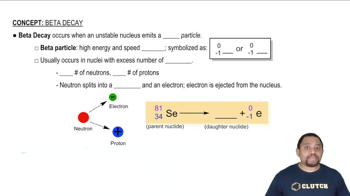
1. Beta emission occurs when a neutron in an atom's nucleus transforms into a proton and emits an electron, also known as a beta particle. This increases the atomic number by 1 because the number of protons in the nucleus increases by 1.
2. The equation for beta decay can be written as: \(n^0_1 \rightarrow p^+_1 + e^-_0\). Here, \(n^0_1\) represents a neutron, \(p^+_1\) represents a proton, and \(e^-_0\) represents an electron or beta particle.
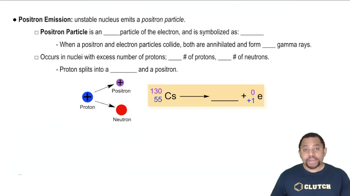
3. Positron emission, on the other hand, occurs when a proton in an atom's nucleus transforms into a neutron and emits a positron (the antimatter counterpart of an electron). This decreases the atomic number by 1 because the number of protons in the nucleus decreases by 1.
4. The equation for positron decay can be written as: \(p^+_1 \rightarrow n^0_1 + e^+_0\). Here, \(p^+_1\) represents a proton, \(n^0_1\) represents a neutron, and \(e^+_0\) represents a positron.
5. In summary, beta emission and positron emission are two types of radioactive decay that change the number of protons in an atom's nucleus, thereby changing the atomic number. Beta emission increases the atomic number, while positron emission decreases it.
비슷한 문제에 대한 검증된 영상 답변:
이 영상 해법은 위 문제에 도움이 된다고 튜터들이 추천한 것입니다.
영상 길이:
1m
영상 재생:
0 댓글
주요 개념
질문에 올바르게 답하기 위해 반드시 이해해야 하는 핵심 개념들은 다음과 같습니다.
Beta Emission
Beta emission is a type of radioactive decay in which a neutron in an unstable nucleus is transformed into a proton, emitting a beta particle (an electron) in the process. This transformation increases the atomic number of the element by one, as the number of protons in the nucleus increases, resulting in a new element that is one position higher on the periodic table.
Positron emission, or beta plus decay, occurs when a proton in an unstable nucleus is converted into a neutron, releasing a positron (the antimatter counterpart of an electron). This process decreases the atomic number of the element by one, as the number of protons decreases, leading to the formation of a new element that is one position lower on the periodic table.
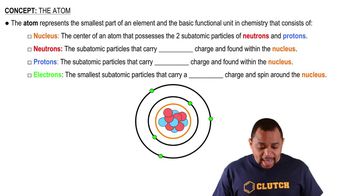
The atomic number of an element is defined as the number of protons in its nucleus, which determines the element's identity and its position in the periodic table. Changes in the atomic number due to nuclear reactions, such as beta and positron emissions, directly affect the chemical properties of the resulting element, as it alters the number of protons and, consequently, the electron configuration.


 검증된 단계별 안내
 03:01
03:01