Ch.21 - Transition Elements and Coordination Chemistry
McMurry - Chemistry 8th Edition
McMurry8th EditionChemistryISBN: 9781292336145당신이 사용하는 게 아니라요?교과서 변경
21장, 문제 21.112

Draw a crystal field energy-level diagram for a square planar complex, and explain why square planar geometry is especially common for d8 complexes.

검증된 단계별 안내
1
Identify the metal ion and its oxidation state in the square planar complex. This will help determine the electron configuration and the number of d electrons present.
Understand that in a square planar complex, the ligands are positioned at the corners of a square in the xy-plane, leading to a specific splitting pattern of the d orbitals.
Recognize that the d orbitals split into different energy levels due to the ligand field. For a square planar complex, the order of increasing energy is typically: dz2, dxy, dyz = dxz, and dx2-y2.
Place the d electrons into the energy levels according to Hund's rule and the Pauli exclusion principle, starting from the lowest energy level. For a d8 complex, fill the lower energy orbitals first.
Explain that square planar geometry is common for d8 complexes because it allows for a stable electron configuration with lower energy, minimizing electron repulsion and maximizing ligand field stabilization energy.

비슷한 문제에 대한 검증된 영상 답변:

이 영상 해법은 위 문제에 도움이 된다고 튜터들이 추천한 것입니다.
도움이 되었나요?

주요 개념

질문에 올바르게 답하기 위해 반드시 이해해야 하는 핵심 개념들은 다음과 같습니다.

Crystal Field Theory

Crystal Field Theory (CFT) explains how the arrangement of ligands around a central metal ion affects the energy levels of the d-orbitals. In a square planar geometry, the ligands are positioned in a way that causes specific splitting of the d-orbitals, leading to distinct energy levels. This theory helps predict the electronic structure and color of coordination complexes.
추천 영상:
가이드 코스
01:18
The study of ligand-metal interactions helped to form Ligand Field Theory which combines CFT with MO Theory.

d<sup>8</sup> Electron Configuration

The d<sup>8</sup> electron configuration refers to transition metal complexes that have eight electrons in their d-orbitals. This configuration is particularly stable in square planar complexes, as it allows for optimal pairing of electrons and minimizes electron-electron repulsion. Common examples include complexes of metals like nickel(II) and platinum(II).
추천 영상:
가이드 코스
01:33
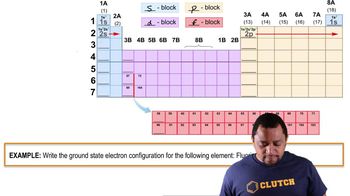
Electron Configuration Example

Ligand Field Stabilization Energy (LFSE)

Ligand Field Stabilization Energy (LFSE) is the energy difference between the actual electronic configuration of a complex and the hypothetical configuration where all d-electrons are in the highest energy level. In square planar complexes, d<sup>8</sup> configurations can achieve a high LFSE due to effective pairing and lower energy arrangements, making this geometry energetically favorable.
추천 영상:
가이드 코스
02:40
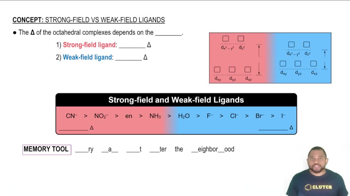
Strong-Field Ligands result in a large Δ and Weak-Field Ligands result in a small Δ.