Ch.21 - Transition Elements and Coordination Chemistry
McMurry - Chemistry 8th Edition
McMurry8th EditionChemistryISBN: 9781292336145당신이 사용하는 게 아니라요?교과서 변경
21장, 문제 21.127b

For each of the following complexes, describe the bonding using valence bond theory. Include orbital diagrams for the free metal ion and the metal ion in the complex. Indicate which hybrid orbitals the metal ion uses for bonding, and specify the number of unpaired electrons. 
(b) [Ag(NH3)2]+

검증된 단계별 안내
1
Identify the central metal ion in the complex. In this case, it is Ag^+.
Determine the electron configuration of the free metal ion, Ag^+. Silver (Ag) has an atomic number of 47, so its electron configuration is [Kr] 4d^10 5s^1. As Ag^+ loses one electron, the configuration becomes [Kr] 4d^10.
Draw the orbital diagram for the free metal ion, Ag^+. Since Ag^+ has a filled 4d subshell, all 4d orbitals are paired, and there are no unpaired electrons.
Consider the ligands and their effect on the metal ion. NH3 is a neutral ligand and acts as a Lewis base, donating a pair of electrons to the metal ion. In [Ag(NH3)2]^+, the Ag^+ ion forms two coordinate covalent bonds with NH3 ligands.
Determine the hybridization of the metal ion in the complex. For [Ag(NH3)2]^+, the Ag^+ ion uses sp hybrid orbitals to accommodate the two pairs of electrons from the NH3 ligands, resulting in a linear geometry around the metal ion.

비슷한 문제에 대한 검증된 영상 답변:

이 영상 해법은 위 문제에 도움이 된다고 튜터들이 추천한 것입니다.
도움이 되었나요?

주요 개념

질문에 올바르게 답하기 위해 반드시 이해해야 하는 핵심 개념들은 다음과 같습니다.

Valence Bond Theory

Valence Bond Theory (VBT) explains how atoms bond by overlapping their atomic orbitals to form covalent bonds. It emphasizes the role of hybridization, where atomic orbitals mix to create new hybrid orbitals that can accommodate electron pairs. This theory helps in understanding the geometry and bonding characteristics of complexes, such as how the shape of [Ag(NH3)2]+ is determined by the hybridization of the silver ion.
추천 영상:
가이드 코스
00:47
Valence Shell Electron Pair Repulsion Theory

Hybridization

Hybridization is the process of combining atomic orbitals to form new hybrid orbitals that are suitable for the pairing of electrons to form chemical bonds. In the case of [Ag(NH3)2]+, the silver ion undergoes hybridization to form dsp2 hybrid orbitals, which allows it to bond with two ammonia ligands. Understanding hybridization is crucial for predicting the geometry and bond angles in coordination complexes.
추천 영상:

Unpaired Electrons

Unpaired electrons are electrons that are alone in an orbital and are crucial for determining the magnetic properties of a complex. In [Ag(NH3)2]+, the silver ion has a specific electron configuration that can lead to the presence of unpaired electrons, affecting its reactivity and interaction with ligands. Identifying the number of unpaired electrons is essential for understanding the electronic structure and bonding behavior of the metal ion in the complex.
추천 영상:
가이드 코스
04:44
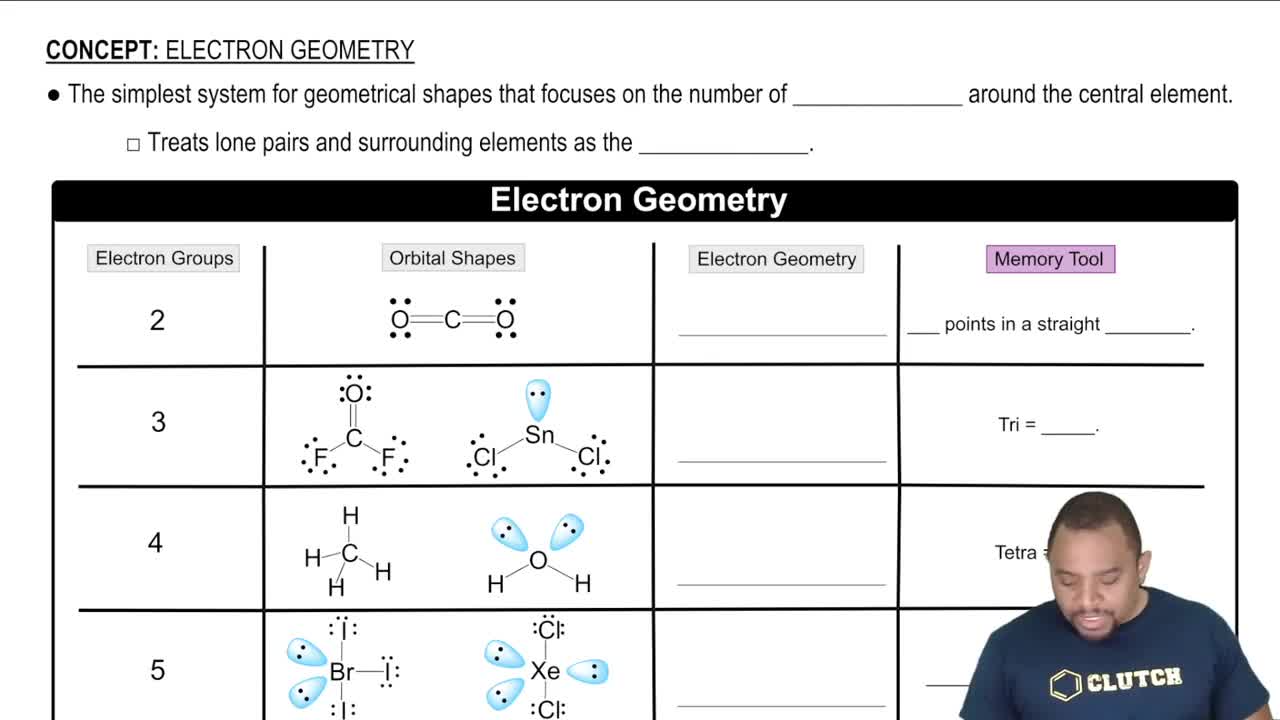
Electron Geometry