
Ch.21 - Transition Elements and Coordination Chemistry
McMurry - Chemistry 8th Edition
McMurry8th EditionChemistryISBN: 9781292336145당신이 사용하는 게 아니라요?교과서 변경
21장, 문제 126c

Give a valence bond description of the bonding in each of the following complexes. Include orbital diagrams for the free metal ion and the metal ion in the complex. Indicate which hybrid orbitals the metal ion uses for bonding, and specify the number of unpaired electrons.
(c) [Fe(CN)6]3- (low-spin)

검증된 단계별 안내
1
Identify the oxidation state of the metal ion in the complex. For [Fe(CN)_6]^{3-}, determine the oxidation state of Fe by considering the charge of the complex and the charge of the ligands.
Determine the electron configuration of the free metal ion. For Fe^{3+}, write the electron configuration and identify the number of unpaired electrons.
Consider the effect of the ligands on the metal ion. CN^- is a strong field ligand, which can cause pairing of electrons in the d orbitals, leading to a low-spin configuration.
Determine the hybridization of the metal ion in the complex. For a low-spin [Fe(CN)_6]^{3-}, identify the hybrid orbitals used for bonding, considering the number of ligands and the geometry of the complex.
Draw the orbital diagrams for the free metal ion and the metal ion in the complex, showing the distribution of electrons and indicating the hybrid orbitals used for bonding. Specify the number of unpaired electrons in the complex.

비슷한 문제에 대한 검증된 영상 답변:

이 영상 해법은 위 문제에 도움이 된다고 튜터들이 추천한 것입니다.
도움이 되었나요?

주요 개념

질문에 올바르게 답하기 위해 반드시 이해해야 하는 핵심 개념들은 다음과 같습니다.

Valence Bond Theory

Valence Bond Theory (VBT) explains how atoms bond by overlapping their atomic orbitals to form covalent bonds. In this theory, the shape and orientation of the orbitals determine the geometry of the molecule. For transition metals, VBT also considers hybridization, where atomic orbitals mix to create new hybrid orbitals that can accommodate bonding with ligands.
추천 영상:
가이드 코스
00:47
Valence Shell Electron Pair Repulsion Theory

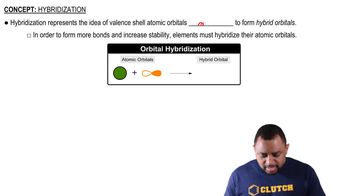
Hybridization

Hybridization is the process of combining atomic orbitals to form new hybrid orbitals that are degenerate in energy. In the case of [Fe(CN)6]3-, the iron ion undergoes hybridization to form d2sp3 hybrid orbitals, which allows it to bond with six cyanide ligands in an octahedral geometry. Understanding the type of hybridization is crucial for predicting the molecular shape and bond angles.
추천 영상:

Electron Configuration and Spin States

The electron configuration of a transition metal ion determines its magnetic properties and the number of unpaired electrons. In low-spin complexes like [Fe(CN)6]3-, the presence of strong field ligands like CN- causes pairing of electrons in the lower energy d-orbitals, resulting in fewer unpaired electrons. This concept is essential for understanding the magnetic behavior and stability of the complex.
추천 영상:
가이드 코스
01:32
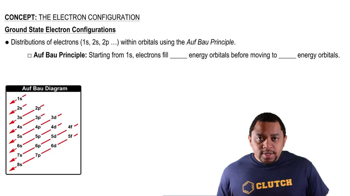
Ground State Electron Configurations