
Ch.21 - Transition Elements and Coordination Chemistry
McMurry - Chemistry 8th Edition
McMurry8th EditionChemistryISBN: 9781292336145당신이 사용하는 게 아니라요?교과서 변경
21장, 문제 21.138e

In acidic aqueous solution, the complex trans-[Co(en)2Cl1]2+(aq) undergoes the following substitution reaction:
trans-[Co(en)2Cl1]+(aq) + H2O(l) → trans-[Co(en)2(H2O)Cl]2+(aq) + Cl(aq)
The reaction is first order in trans-[Co(en)2Cl2]+(aq), and the rate constant at 25°C is 3.2×10⁻⁵ s–1.
e. Draw a crystal field energy-level diagram for trans-[Co(en)2Cl2]+ that takes account of the fact that Cl is a weaker-field ligand than ethylenediamine.

검증된 단계별 안내
1
Identify the metal center and its oxidation state in the complex trans-[Co(en)_2Cl_2]^+.
Recognize that Cl^- is a weaker-field ligand compared to ethylenediamine (en), which affects the splitting of the d-orbitals.
Draw the octahedral crystal field splitting diagram, noting that the presence of weaker-field ligands like Cl^- results in a smaller splitting energy (Δ).
Label the d-orbitals in the diagram as t_2g (lower energy) and e_g (higher energy) levels, considering the octahedral geometry.
Populate the d-orbitals with electrons according to the electron configuration of Co^3+ (d^6), considering the weak-field nature of Cl^- which may lead to high-spin configuration.

비슷한 문제에 대한 검증된 영상 답변:

이 영상 해법은 위 문제에 도움이 된다고 튜터들이 추천한 것입니다.
도움이 되었나요?

주요 개념

질문에 올바르게 답하기 위해 반드시 이해해야 하는 핵심 개념들은 다음과 같습니다.

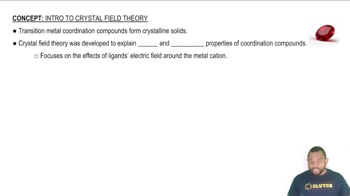
Crystal Field Theory

Crystal Field Theory (CFT) explains the electronic structure of transition metal complexes by considering the effect of ligands on the d-orbitals of the metal ion. In an octahedral field, the d-orbitals split into two energy levels: the lower-energy t2g and the higher-energy eg orbitals. The extent of this splitting depends on the nature of the ligands, with stronger field ligands causing greater splitting. Understanding this concept is crucial for predicting the electronic transitions and colors of complexes.
추천 영상:
가이드 코스
01:18
The study of ligand-metal interactions helped to form Ligand Field Theory which combines CFT with MO Theory.

Ligand Field Strength

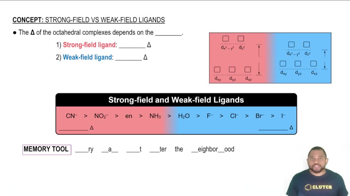
Ligand field strength refers to the ability of a ligand to split the d-orbitals of a central metal ion in a coordination complex. Ligands are classified as strong or weak field based on their ability to cause d-orbital splitting. Ethylenediamine (en) is a strong field ligand, leading to significant splitting, while chloride (Cl-) is a weak field ligand, resulting in less splitting. This concept is essential for understanding the stability and reactivity of metal complexes.
추천 영상:
가이드 코스
02:40
Strong-Field Ligands result in a large Δ and Weak-Field Ligands result in a small Δ.

First-Order Reaction Kinetics

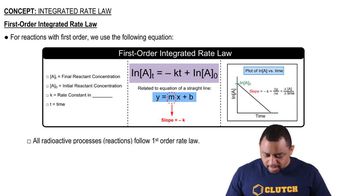
First-order reaction kinetics describes a reaction where the rate is directly proportional to the concentration of one reactant. In this case, the substitution reaction involving trans-[Co(en)2Cl2]+ is first-order with respect to the complex, meaning that as its concentration decreases, the rate of reaction also decreases. The rate constant, given as 3.2×10⁻⁵ s–1, allows for the calculation of reaction rates and is fundamental for understanding the dynamics of the substitution process.
추천 영상:
가이드 코스
02:29
First-Order Reactions
관련 실천
교과서 질문

Cobalt(III) trifluoroacetylacetonate, Co1tfac23, is a sixcoordinate, octahedral metal chelate in which three planar, bidentate tfac ligands are attached to a central Co atom:

(d) Draw a crystal field energy-level diagram for Co1tfac23, and predict its magnetic properties. (In this complex, tfac is a strong-field ligand.)

111
views
교과서 질문

In acidic aqueous solution, the complex trans-[Co(en)2Cl1]2+(aq) undergoes the following substitution reaction:

trans-[Co(en)1Cl2]+(aq) + H2O(l) → trans-[Co(en)2(H2O)Cl]2+(aq) + Cl(aq)

The reaction is first order in trans-[Co(en)2Cl2]+(aq), and the rate constant at 25°C is 3.2×10⁻⁵ s–1.

(d) Is the reaction product chiral or achiral? Explain.

77
views
교과서 질문

Locate on the periodic table the transition elements with the following electron configurations. Identify each element.

(c) [Kr] 4d25s2

(d) [Xe] 4f36s2

91
views
교과서 질문

Locate on the periodic table the transition elements with the following electron configurations. Identify each element.

(a) [Ar] 3d74s2

(b) [Ar] 3d54s1

98
views
교과서 질문

The complete reaction of 2.60 g of chromium metal with 50.00 mL of 1.200 M H2SO4 in the absence of air gave a blue solution and a colorless gas that was collected at 25°C and a pressure of 735 mm Hg. (e) When an excess of KCN is added to the solution, the color changes, and the paramagnetism of the solution

decreases. Explain.

103
views
교과서 질문

Spinach contains a lot of iron but is not a good source of dietary iron because nearly all the iron is tied up in the oxalate complex [Fe(C2O4)3]3-.

(d) Draw the structure of [Fe(C2O4)3]3-. Is the complex chiral or achiral?

83
views