
Ch.21 - Transition Elements and Coordination Chemistry
McMurry - Chemistry 8th Edition
McMurry8th EditionChemistryISBN: 9781292336145당신이 사용하는 게 아니라요?교과서 변경
21장, 문제 68

What is the formula, including the charge, for each of the following complexes?
(a) An iridium(III) complex with three ammonia and three chloride ligands
(b) A chromium(III) complex with two water and two oxalate ligands
(c) A platinum(IV) complex with two ethylenediamine and two thiocyanate ligands

검증된 단계별 안내
1
Identify the oxidation state of the central metal in each complex. For (a) iridium(III) indicates an oxidation state of +3 for iridium. For (b) chromium(III) indicates an oxidation state of +3 for chromium. For (c) platinum(IV) indicates an oxidation state of +4 for platinum.
Determine the charge contributed by each ligand. Ammonia (NH3) is a neutral ligand, contributing 0 charge. Chloride (Cl-) is an anionic ligand, contributing -1 charge per ligand. Water (H2O) is a neutral ligand. Oxalate (C2O4^2-) is an anionic ligand, contributing -2 charge per ligand. Ethylenediamine (en) is a neutral ligand. Thiocyanate (SCN-) can bind through either sulfur or nitrogen and is an anionic ligand, contributing -1 charge per ligand.
Calculate the total charge of the ligands for each complex. For (a), three chloride ligands contribute a total charge of -3. For (b), two oxalate ligands contribute a total charge of -4. For (c), two thiocyanate ligands contribute a total charge of -2.
Combine the charges of the central metal and the ligands to determine the overall charge of the complex. For (a), the total charge is +3 (from iridium) + (-3 from ligands) = 0. For (b), the total charge is +3 (from chromium) + (-4 from ligands) = -1. For (c), the total charge is +4 (from platinum) + (-2 from ligands) = +2.
Write the formula for each complex, including the charge. For (a), the formula is [Ir(NH3)3Cl3]. For (b), the formula is [Cr(H2O)2(C2O4)2]^-1. For (c), the formula is [Pt(en)2(SCN)2]^+2.

비슷한 문제에 대한 검증된 영상 답변:

이 영상 해법은 위 문제에 도움이 된다고 튜터들이 추천한 것입니다.
도움이 되었나요?

주요 개념

질문에 올바르게 답하기 위해 반드시 이해해야 하는 핵심 개념들은 다음과 같습니다.

Coordination Complexes

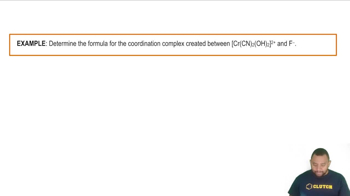
Coordination complexes consist of a central metal atom or ion bonded to surrounding molecules or ions known as ligands. The nature of these ligands, whether neutral or charged, influences the overall charge of the complex. Understanding how ligands coordinate to the metal is essential for determining the formula and charge of the complex.
추천 영상:
가이드 코스
00:43
Coordination Complexes Example

Oxidation States

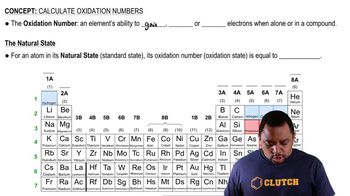
The oxidation state of a metal in a coordination complex indicates its charge and is crucial for writing the correct formula. For example, iridium(III) indicates that iridium has a +3 charge. Knowing the oxidation states of the metal and the charges of the ligands allows for accurate calculation of the overall charge of the complex.
추천 영상:
가이드 코스
02:42
Oxidation Numbers

Ligand Types and Charges

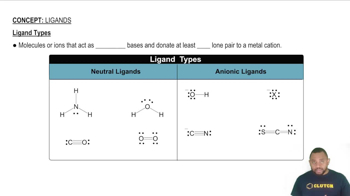
Ligands can be classified as neutral or charged, and their individual charges must be considered when determining the overall charge of the complex. For instance, ammonia is a neutral ligand, while chloride carries a -1 charge. Understanding the types of ligands and their respective charges is essential for constructing the correct chemical formula for the complexes.
추천 영상: