
교과서 질문
What is the highest oxidation state for each of the elements from Sc to Zn?
101
views

 검증된 단계별 안내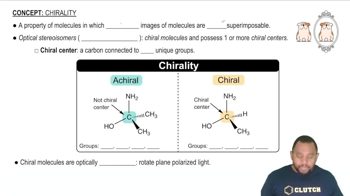
 02:37
02:37
 00:43
00:43 02:02
02:02What is the highest oxidation state for each of the elements from Sc to Zn?
What is a racemic mixture? Does it affect plane-polarized light? Explain.
The amount of paramagnetism for a first-series transition metal complex is related approximately to its spin-only magnetic moment. The spin-only value of the magnetic moment in units of Bohr magnetons (BM) is given by sqrt(n(n + 2)), where n is the number of unpaired electrons. Calculate the spin-only value of the magnetic moment for the 2+ ions of the first-series transition metals (except Sc) in octahedral complexes with (a) weak-field ligands and (b) strong-field ligands. For which electron configurations can the magnetic moment distinguish between high-spin and low-spin electron configurations?
Based on effective nuclear charge (Zeff), which ion is the strongest oxidizing agent?
(a) Cu2+
(b) Ni2+
(c) Fe2+
(d) Mn2+
What hybrid orbitals are used by the metal ion and how many unpaired electrons are present the complex ion [VCl4]- with tetrahedral geometry?
(a) sp3; 2 unpaired electrons
(b) sp3; 3 unpaired electrons
(c) sp3d2; 3 unpaired electrons
(d) sp3d2; 4 unpaired electrons
Predict the number of unpaired electrons for each of the following.
(a) Sc3+
(b) Co2+