Ch.22 - The Main Group Elements
McMurry - Chemistry 8th Edition
McMurry8th EditionChemistryISBN: 9781292336145당신이 사용하는 게 아니라요?교과서 변경
22장, 문제 112

Account for each of the following observations: (b) Phosphorous acid is a diprotic acid.

검증된 단계별 안내
1
Phosphorous acid, with the chemical formula H₃PO₃, is an oxyacid of phosphorus.
In phosphorous acid, the structure consists of one phosphorus atom bonded to three hydrogen atoms and three oxygen atoms, with one of the hydrogen atoms directly bonded to the phosphorus atom.
The hydrogen atom directly bonded to the phosphorus atom is not ionizable, meaning it does not dissociate in water to release a proton (H⁺).
The remaining two hydrogen atoms are bonded to oxygen atoms, forming hydroxyl groups (OH), which can dissociate in water to release protons.
Since only two of the hydrogen atoms can dissociate to release protons, phosphorous acid is classified as a diprotic acid, meaning it can donate two protons per molecule.

주요 개념

질문에 올바르게 답하기 위해 반드시 이해해야 하는 핵심 개념들은 다음과 같습니다.

Diprotic Acids

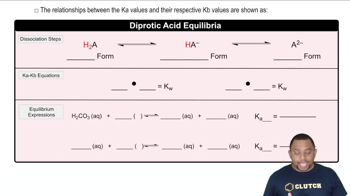
Diprotic acids are acids that can donate two protons (H⁺ ions) per molecule in an aqueous solution. This characteristic allows them to undergo two distinct ionization steps, resulting in the formation of two different conjugate bases. An example of a diprotic acid is phosphorous acid (H₃PO₃), which can lose two protons to form H₂PO₃⁻ and HPO₃²⁻.
추천 영상:
가이드 코스
04:41
3 forms of Diprotic Acids

Ionization of Acids

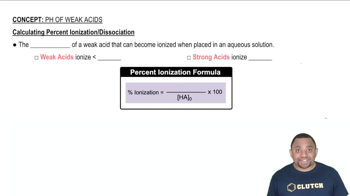
The ionization of acids refers to the process by which an acid donates protons to water, resulting in the formation of hydronium ions (H₃O⁺) and conjugate bases. For diprotic acids, this process occurs in two stages, each with its own equilibrium constant (Ka). Understanding this concept is crucial for predicting the behavior of diprotic acids in solution and their relative strengths.
추천 영상:
가이드 코스
01:15
Calculating Percent Ionization of Weak Acids

Acid Strength and pKa

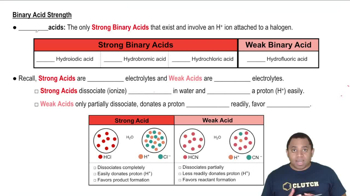
The strength of an acid is often measured by its dissociation constant (Ka) and its negative logarithm (pKa). A lower pKa value indicates a stronger acid, meaning it more readily donates protons. For diprotic acids, the first dissociation typically has a higher Ka (lower pKa) than the second, reflecting the decreasing tendency to lose a second proton as the solution becomes more negatively charged.
추천 영상:
가이드 코스
03:51
Binary Acid Strengths