Ch.22 - The Main Group Elements

McMurry8th EditionChemistryISBN: 9781292336145
당신이 사용하는 게 아니라요?교과서 변경다른 교과서를 선택하세요
TOC.tableOfContents
- Ch.1 - Chemical Tools: Experimentation & Measurement170
- Ch.2 - Atoms, Molecules & Ions160
- Ch.3 - Mass Relationships in Chemical Reactions169
- Ch.4 - Reactions in Aqueous Solution199
- Ch.5 - Periodicity & Electronic Structure of Atoms102
- Ch.6 - Ionic Compounds: Periodic Trends and Bonding Theory92
- Ch.7 - Covalent Bonding and Electron-Dot Structures61
- Ch.8 - Covalent Compounds: Bonding Theories and Molecular Structure59
- Ch.9 - Thermochemistry: Chemical Energy122
- Ch.10 - Gases: Their Properties & Behavior155
- Ch.11 - Liquids & Phase Changes54
- Ch.12 - Solids and Solid-State Materials73
- Ch.13 - Solutions & Their Properties120
- Ch.14 - Chemical Kinetics98
- Ch.15 - Chemical Equilibrium125
- Ch.16 - Aqueous Equilibria: Acids & Bases110
- Ch.17 - Applications of Aqueous Equilibria147
- Ch.18 - Thermodynamics: Entropy, Free Energy & Equilibrium86
- Ch.19 - Electrochemistry154
- Ch.20 - Nuclear Chemistry96
- Ch.21 - Transition Elements and Coordination Chemistry156
- Ch.22 - The Main Group Elements187
- Ch.23 - Organic and Biological Chemistry51

22장, 문제 37
Arrange the following elements in order of increasing electronegativity: (a) Sr (b) Cl (c) Sn (d) Ge.
 검증된 단계별 안내
1
Step 1: Understand the concept of electronegativity, which is the ability of an atom to attract electrons in a chemical bond. Electronegativity values are typically found on the Pauling scale.
Step 2: Recall the general trend of electronegativity on the periodic table: it increases across a period (from left to right) and decreases down a group (from top to bottom).
Step 3: Locate the elements on the periodic table: Sr (Strontium) is in Group 2, Cl (Chlorine) is in Group 17, Sn (Tin) is in Group 14, and Ge (Germanium) is also in Group 14.
Step 4: Compare the positions of these elements: Cl is to the right of Ge and Sn, and above them in the periodic table, indicating it has the highest electronegativity. Sr is further left and down, indicating it has the lowest electronegativity.
Step 5: Arrange the elements in order of increasing electronegativity based on their positions and the trends: Sr < Sn < Ge < Cl.
주요 개념
질문에 올바르게 답하기 위해 반드시 이해해야 하는 핵심 개념들은 다음과 같습니다.
Electronegativity
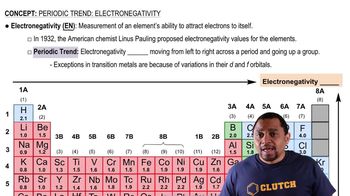
Electronegativity is a measure of an atom's ability to attract and hold onto electrons when it forms a chemical bond. It is a key concept in understanding how atoms interact in molecules. The scale of electronegativity, developed by Linus Pauling, ranges from low values for metals to high values for nonmetals, influencing bond polarity and molecular properties.
추천 영상:
가이드 코스
 02:10
02:10
Electronegativity Trends
Periodic Trends
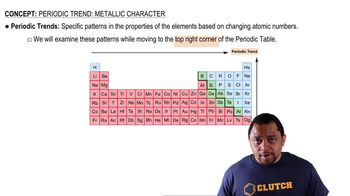
Periodic trends refer to the predictable patterns observed in the properties of elements across the periodic table. Electronegativity generally increases from left to right across a period and decreases from top to bottom within a group. Understanding these trends helps in predicting the electronegativity of elements based on their position in the periodic table.
추천 영상:
가이드 코스
 00:38
00:38Periodic Trends
Comparison of Elements
When comparing the electronegativity of different elements, it is essential to consider their positions in the periodic table. For instance, nonmetals like chlorine (Cl) typically have higher electronegativity than metalloids like germanium (Ge) or metals like strontium (Sr). This comparison allows for the arrangement of elements in order of increasing electronegativity.
추천 영상:
가이드 코스
 02:35
02:35Elemental Forms of Elements
관련 실천