Ch.22 - The Main Group Elements
McMurry - Chemistry 8th Edition
McMurry8th EditionChemistryISBN: 9781292336145당신이 사용하는 게 아니라요?교과서 변경
22장, 문제 49

Carbon, nitrogen, and oxygen form π bonds, but fluorine does not. Explain.

검증된 단계별 안내
1
Step 1: Understand the concept of π bonds. π bonds are formed by the sideways overlap of p orbitals. They are typically found in double and triple bonds, where one of the bonds is a σ bond and the others are π bonds.
Step 2: Consider the atomic size and electronegativity. Carbon, nitrogen, and oxygen have relatively small atomic sizes and moderate electronegativity, allowing their p orbitals to overlap effectively to form π bonds.
Step 3: Analyze the case of fluorine. Fluorine is highly electronegative and has a small atomic size, which leads to a strong attraction for its own electrons, making it less likely to share electrons through π bonding.
Step 4: Examine the electron configuration. Fluorine's electron configuration ends in 2p^5, meaning it has one unpaired electron in the p orbital, which is more likely to form a σ bond rather than a π bond due to its high electronegativity.
Step 5: Conclude with the stability of π bonds. The formation of π bonds requires effective overlap and sharing of electrons, which is less favorable for fluorine due to its high electronegativity and tendency to hold onto its electrons tightly, thus preferring σ bonds.

주요 개념

질문에 올바르게 답하기 위해 반드시 이해해야 하는 핵심 개념들은 다음과 같습니다.

π Bonds

π bonds are a type of covalent bond formed when two lobes of one involved atomic orbital overlap with two lobes of another, typically occurring in double and triple bonds. They arise from the side-to-side overlap of p orbitals, allowing for the sharing of electrons between atoms. Carbon, nitrogen, and oxygen can form π bonds due to their ability to engage in hybridization and have available p orbitals.
추천 영상:

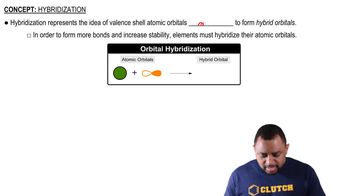
Hybridization

Hybridization is the concept of mixing atomic orbitals to create new hybrid orbitals that can form bonds with other atoms. For example, carbon can undergo sp² or sp³ hybridization, allowing it to form multiple bonds, including π bonds. Nitrogen and oxygen also participate in hybridization, enabling them to form stable π bonds in their molecular structures.
추천 영상:

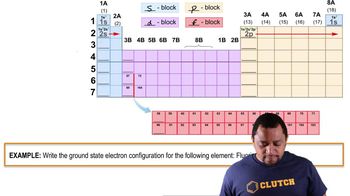
Fluorine's Electron Configuration

Fluorine has an electron configuration of 1s² 2s² 2p⁵, which means it has only one unpaired electron in its 2p orbital. This configuration limits its ability to form π bonds, as it prefers to form single bonds through σ bonding by sharing its unpaired electron. Additionally, fluorine's high electronegativity and small size make it less likely to engage in the types of bonding that involve π interactions.
추천 영상:
가이드 코스
01:33
Electron Configuration Example