Ch.22 - The Main Group Elements
McMurry - Chemistry 8th Edition
McMurry8th EditionChemistryISBN: 9781292336145당신이 사용하는 게 아니라요?교과서 변경
22장, 문제 72

Complete the following equations so that the same numbers and kinds of atoms appear on both sides of the reaction arrow. If no reaction takes place, write N.R. (a) Cs(s) + H2O(l) → ? (b) Rb(s) + O2(g) → ?

검증된 단계별 안내
1
Step 1: Identify the type of reaction for each equation. For (a), Cs(s) + H2O(l), this is a single displacement reaction where a metal reacts with water. For (b), Rb(s) + O2(g), this is a synthesis reaction where a metal reacts with oxygen.
Step 2: Write the products for each reaction. In (a), when an alkali metal like Cs reacts with water, it typically forms a hydroxide and hydrogen gas. In (b), when an alkali metal like Rb reacts with oxygen, it forms a metal oxide.
Step 3: For (a), write the unbalanced equation: Cs(s) + H2O(l) → CsOH(aq) + H2(g). For (b), write the unbalanced equation: Rb(s) + O2(g) → Rb2O(s).
Step 4: Balance the equation for (a). Start by balancing the Cs atoms, then the O and H atoms. Ensure the number of each type of atom is the same on both sides of the equation.
Step 5: Balance the equation for (b). Start by balancing the Rb atoms, then the O atoms. Ensure the number of each type of atom is the same on both sides of the equation.

주요 개념

질문에 올바르게 답하기 위해 반드시 이해해야 하는 핵심 개념들은 다음과 같습니다.

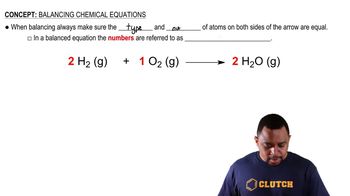
Balancing Chemical Equations

Balancing chemical equations involves ensuring that the number of atoms of each element is the same on both sides of the equation. This is based on the law of conservation of mass, which states that matter cannot be created or destroyed in a chemical reaction. To balance an equation, coefficients are adjusted in front of the chemical formulas, rather than changing the formulas themselves.
추천 영상:
가이드 코스
01:32
Balancing Chemical Equations

Reactivity of Alkali Metals

Alkali metals, such as cesium (Cs) and rubidium (Rb), are highly reactive, especially with water and oxygen. When alkali metals react with water, they typically produce hydroxides and hydrogen gas. In the case of oxygen, they form metal oxides. Understanding these reactions is crucial for predicting the products of the given equations.
추천 영상:
가이드 코스
03:12
Transition Metals

Types of Chemical Reactions

Chemical reactions can be classified into several types, including synthesis, decomposition, single replacement, and combustion. The reactions in the question involve single replacement reactions, where an element reacts with a compound, and the more reactive element displaces another. Recognizing the type of reaction helps in predicting the products and balancing the equations correctly.
추천 영상:
가이드 코스
02:25
Common Types of Alkane Reactions