Ch.22 - The Main Group Elements
McMurry - Chemistry 8th Edition
McMurry8th EditionChemistryISBN: 9781292336145당신이 사용하는 게 아니라요?교과서 변경
22장, 문제 159

What is the electron-dot structure and geometry of XeO3?

검증된 단계별 안내
1
Step 1: Determine the total number of valence electrons available. Xenon (Xe) has 8 valence electrons, and each oxygen (O) has 6 valence electrons. Since there are three oxygen atoms, the total number of valence electrons is 8 + (3 * 6).
Step 2: Draw the skeletal structure of the molecule. Place the xenon (Xe) atom in the center and connect it to the three oxygen (O) atoms with single bonds.
Step 3: Distribute the remaining valence electrons to satisfy the octet rule for each oxygen atom. Start by placing lone pairs on the oxygen atoms until each has 8 electrons (including the bonding electrons).
Step 4: Check if the central xenon atom has a complete octet. If not, consider forming double bonds between xenon and oxygen atoms to ensure that xenon also satisfies the octet rule.
Step 5: Determine the molecular geometry using VSEPR theory. Count the number of bonding pairs and lone pairs around the central xenon atom to predict the shape of the molecule. XeO3 has three bonding pairs and one lone pair, leading to a trigonal pyramidal geometry.

주요 개념

질문에 올바르게 답하기 위해 반드시 이해해야 하는 핵심 개념들은 다음과 같습니다.

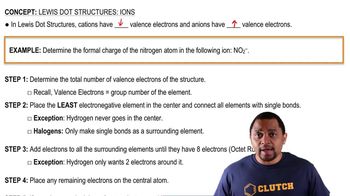
Electron-Dot Structure

The electron-dot structure, also known as the Lewis structure, represents the valence electrons of atoms within a molecule. It uses dots to depict the electrons and lines to indicate bonds between atoms. For XeO3, the structure helps visualize how xenon and oxygen atoms are bonded and the distribution of lone pairs, which is crucial for understanding molecular geometry.
추천 영상:
가이드 코스
04:28
Lewis Dot Structures: Ions

Molecular Geometry

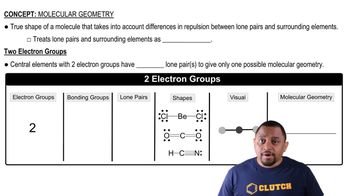
Molecular geometry refers to the three-dimensional arrangement of atoms in a molecule. It is determined by the number of bonding pairs and lone pairs of electrons around the central atom, following the VSEPR (Valence Shell Electron Pair Repulsion) theory. For XeO3, the geometry can be predicted based on the arrangement of the bonded oxygen atoms and the lone pairs on xenon.
추천 영상:
가이드 코스
01:33
Molecular Geometry with Two Electron Groups

VSEPR Theory

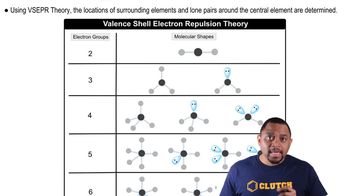
VSEPR theory is a model used to predict the shape of molecules based on the repulsion between electron pairs. According to this theory, electron pairs will arrange themselves to minimize repulsion, leading to specific geometries. In the case of XeO3, VSEPR theory helps determine that the molecule adopts a trigonal pyramidal shape due to the presence of lone pairs on the xenon atom.
추천 영상:
가이드 코스
02:13
Molecular Shapes and VSEPR