Ch.22 - The Main Group Elements
McMurry - Chemistry 8th Edition
McMurry8th EditionChemistryISBN: 9781292336145당신이 사용하는 게 아니라요?교과서 변경
22장, 문제 122

If an element forms an acidic oxide, is it more likely to form an ionic or covalent hydride?

검증된 단계별 안내
1
Step 1: Understand the nature of acidic oxides. Acidic oxides are typically formed by nonmetals and react with water to form acids. They are often covalent in nature.
Step 2: Recall the general properties of elements that form covalent compounds. Nonmetals, which form acidic oxides, tend to share electrons and form covalent bonds.
Step 3: Consider the types of hydrides. Hydrides can be ionic or covalent. Ionic hydrides are usually formed by metals, while covalent hydrides are formed by nonmetals.
Step 4: Relate the formation of acidic oxides to the type of hydride. Since elements that form acidic oxides are typically nonmetals, they are more likely to form covalent hydrides.
Step 5: Conclude that an element forming an acidic oxide is more likely to form a covalent hydride due to its nonmetallic character and tendency to share electrons.

주요 개념

질문에 올바르게 답하기 위해 반드시 이해해야 하는 핵심 개념들은 다음과 같습니다.

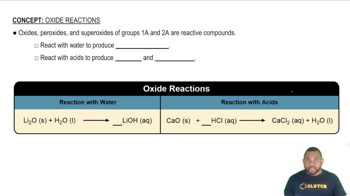
Acidic Oxides

Acidic oxides are oxides that react with water to form acids or with bases to form salts. They are typically formed by nonmetals or metalloids and exhibit covalent bonding characteristics. Understanding the nature of acidic oxides helps in predicting the behavior of the corresponding hydrides, as these oxides often indicate the element's tendency to form covalent compounds.
추천 영상:
가이드 코스
00:58
Oxide Reactions

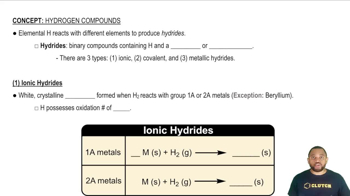
Ionic vs. Covalent Hydrides

Hydrides can be classified as ionic or covalent based on the type of bonding present. Ionic hydrides are formed between metals and hydrogen, characterized by the transfer of electrons, while covalent hydrides involve the sharing of electrons between nonmetals and hydrogen. The nature of the hydride formed is influenced by the element's electronegativity and its bonding characteristics, which are often indicated by the type of oxide it forms.
추천 영상:

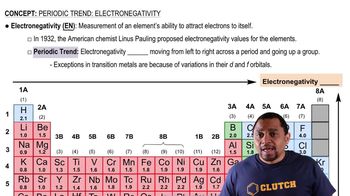
Electronegativity and Bonding

Electronegativity is a measure of an atom's ability to attract and hold onto electrons. Elements with high electronegativity tend to form covalent bonds, while those with lower electronegativity are more likely to form ionic bonds. In the context of the question, an element that forms an acidic oxide typically has high electronegativity, suggesting that it is more likely to form a covalent hydride rather than an ionic one.
추천 영상:
가이드 코스
02:10
Electronegativity Trends