Ch.22 - The Main Group Elements
McMurry - Chemistry 8th Edition
McMurry8th EditionChemistryISBN: 9781292336145당신이 사용하는 게 아니라요?교과서 변경
22장, 문제 148

Reaction of titanium and chlorine at 300 °C yields a metal halide that is 25.25% Ti by mass. The melting point (124 °C) and boiling point (136 °C) of the halide suggest it is a molecular compound rather than an ionic one. (a) What are the formula and name of the compound, assuming the molecular formula is the same as the empirical formula? (b) Write the balanced equation for the reaction.

검증된 단계별 안내
1
Step 1: Determine the empirical formula of the compound. Assume 100 g of the compound, which means it contains 25.25 g of Ti. Calculate the moles of Ti using its molar mass (47.87 g/mol).
Step 2: Calculate the mass of chlorine in the compound by subtracting the mass of titanium from the total mass (100 g - 25.25 g = 74.75 g of Cl). Then, calculate the moles of Cl using its molar mass (35.45 g/mol).
Step 3: Determine the simplest whole number ratio of moles of Ti to moles of Cl to find the empirical formula. Divide the moles of each element by the smallest number of moles calculated.
Step 4: Since the problem states that the molecular formula is the same as the empirical formula, use the empirical formula as the molecular formula. Name the compound based on its formula.
Step 5: Write the balanced chemical equation for the reaction of titanium with chlorine gas to form the compound. Use the stoichiometry of the reaction to ensure the equation is balanced.

주요 개념

질문에 올바르게 답하기 위해 반드시 이해해야 하는 핵심 개념들은 다음과 같습니다.

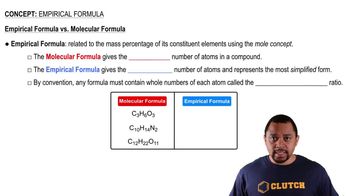
Empirical and Molecular Formulas

The empirical formula represents the simplest whole-number ratio of elements in a compound, while the molecular formula indicates the actual number of atoms of each element in a molecule. In this question, the mass percentage of titanium allows us to determine the empirical formula, which is assumed to be the same as the molecular formula for the metal halide.
추천 영상:
가이드 코스
02:26
Empirical vs Molecular Formula

Stoichiometry

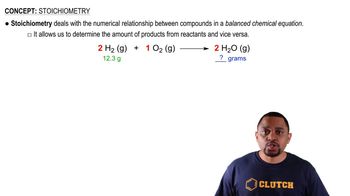
Stoichiometry involves the calculation of reactants and products in chemical reactions based on the conservation of mass. It allows us to balance chemical equations, ensuring that the number of atoms for each element is the same on both sides of the equation. This is essential for writing the balanced equation for the reaction between titanium and chlorine.
추천 영상:
가이드 코스
01:16
Stoichiometry Concept

Properties of Ionic vs. Molecular Compounds

Ionic compounds typically have high melting and boiling points and conduct electricity when dissolved in water, while molecular compounds generally have lower melting and boiling points and do not conduct electricity. The given melting and boiling points of the titanium halide suggest it is a molecular compound, which influences the expected formula and properties of the product formed in the reaction.
추천 영상:
가이드 코스
02:11
Ionic Compounds Naming