
Ch.22 - The Main Group Elements
McMurry - Chemistry 8th Edition
McMurry8th EditionChemistryISBN: 9781292336145당신이 사용하는 게 아니라요?교과서 변경
22장, 문제 22.31a

The following pictures represent various silicate anions. Write the formula and charge of each anion.

검증된 단계별 안내
1
insert step 1> Identify the type of silicate structure for each anion in the pictures. Common types include orthosilicates, pyrosilicates, cyclic silicates, chain silicates, and sheet silicates.
insert step 2> Determine the basic formula for each type of silicate anion. For example, orthosilicates have the formula SiO_4^{4-}, pyrosilicates have Si_2O_7^{6-}, etc.
insert step 3> Count the number of silicon (Si) and oxygen (O) atoms in each anion structure to verify the specific formula.
insert step 4> Calculate the charge of each anion by considering the oxidation state of silicon (+4) and oxygen (-2), and ensuring the overall charge matches the typical charge for that silicate type.
insert step 5> Write down the chemical formula and charge for each silicate anion based on your analysis from the previous steps.

비슷한 문제에 대한 검증된 영상 답변:

이 영상 해법은 위 문제에 도움이 된다고 튜터들이 추천한 것입니다.
도움이 되었나요?

주요 개념

질문에 올바르게 답하기 위해 반드시 이해해야 하는 핵심 개념들은 다음과 같습니다.

Silicate Anions

Silicate anions are polyatomic ions composed of silicon and oxygen, typically represented by the general formula SiO4^n-. They form the basis of silicate minerals and can vary in structure and charge depending on the arrangement of silicon and oxygen atoms. Understanding the different types of silicate anions, such as orthosilicate (SiO4^4-) and pyrosilicate (Si2O7^6-), is essential for identifying their formulas and charges.
추천 영상:
가이드 코스
14:42
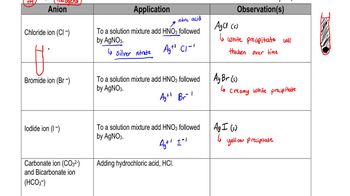
Test for Anions

Polyatomic Ions

Polyatomic ions are ions that consist of two or more atoms bonded together, carrying a net charge due to the loss or gain of electrons. They play a crucial role in chemical reactions and compound formation. Recognizing the common polyatomic ions, including their formulas and charges, is vital for accurately writing the formulas of silicate anions and understanding their behavior in chemical contexts.
추천 영상:
가이드 코스
01:20
Polyatomic Ion Variations

Charge Balance in Ionic Compounds

In ionic compounds, the total positive charge must balance the total negative charge to achieve electrical neutrality. This principle is fundamental when writing chemical formulas, as it dictates the ratio of cations to anions. For silicate anions, knowing their charges allows for the correct combination with cations to form stable compounds, ensuring that the overall charge of the resulting formula is zero.
추천 영상:
가이드 코스
02:11
Ionic Compounds Naming
관련 실천