Ch.22 - The Main Group Elements

McMurry8th EditionChemistryISBN: 9781292336145
당신이 사용하는 게 아니라요?교과서 변경다른 교과서를 선택하세요
TOC.tableOfContents
- Ch.1 - Chemical Tools: Experimentation & Measurement170
- Ch.2 - Atoms, Molecules & Ions160
- Ch.3 - Mass Relationships in Chemical Reactions169
- Ch.4 - Reactions in Aqueous Solution199
- Ch.5 - Periodicity & Electronic Structure of Atoms102
- Ch.6 - Ionic Compounds: Periodic Trends and Bonding Theory92
- Ch.7 - Covalent Bonding and Electron-Dot Structures61
- Ch.8 - Covalent Compounds: Bonding Theories and Molecular Structure59
- Ch.9 - Thermochemistry: Chemical Energy122
- Ch.10 - Gases: Their Properties & Behavior155
- Ch.11 - Liquids & Phase Changes54
- Ch.12 - Solids and Solid-State Materials73
- Ch.13 - Solutions & Their Properties120
- Ch.14 - Chemical Kinetics98
- Ch.15 - Chemical Equilibrium125
- Ch.16 - Aqueous Equilibria: Acids & Bases110
- Ch.17 - Applications of Aqueous Equilibria147
- Ch.18 - Thermodynamics: Entropy, Free Energy & Equilibrium86
- Ch.19 - Electrochemistry154
- Ch.20 - Nuclear Chemistry96
- Ch.21 - Transition Elements and Coordination Chemistry156
- Ch.22 - The Main Group Elements187
- Ch.23 - Organic and Biological Chemistry51

22장, 문제 42
Which of the following compounds are molecular, and which have an extended three-dimensional structure? (a) B2H6 (b) KAlSi3O8 (c) SO3 (d) GeCl4
 검증된 단계별 안내
1
Step 1: Understand the difference between molecular compounds and those with extended three-dimensional structures. Molecular compounds consist of discrete molecules held together by covalent bonds, while compounds with extended structures are typically ionic or covalent networks.
Step 2: Analyze compound (a) B2H6. Diborane (B2H6) is a molecular compound because it consists of discrete B2H6 molecules held together by covalent bonds.
Step 3: Analyze compound (b) KAlSi3O8. This is a mineral known as feldspar, which has an extended three-dimensional structure. It is a network solid with a complex lattice structure involving ionic and covalent bonds.
Step 4: Analyze compound (c) SO3. Sulfur trioxide (SO3) is a molecular compound, consisting of discrete SO3 molecules held together by covalent bonds.
Step 5: Analyze compound (d) GeCl4. Germanium tetrachloride (GeCl4) is a molecular compound, consisting of discrete GeCl4 molecules held together by covalent bonds.
주요 개념
질문에 올바르게 답하기 위해 반드시 이해해야 하는 핵심 개념들은 다음과 같습니다.
Molecular Compounds
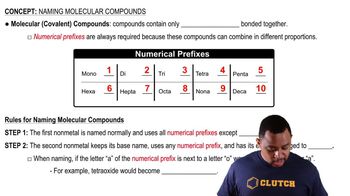
Molecular compounds are formed when two or more nonmetals bond together through covalent bonds, sharing electrons. These compounds typically exist as discrete molecules and have relatively low melting and boiling points. Examples include water (H2O) and sulfur trioxide (SO3), which are characterized by their molecular structure and distinct molecular properties.
추천 영상:
가이드 코스
 02:06
02:06
Naming Molecular Compounds
Ionic Compounds
Ionic compounds consist of positively and negatively charged ions held together by strong electrostatic forces known as ionic bonds. These compounds usually form a crystalline lattice structure, resulting in high melting and boiling points. An example is potassium aluminum silicate (KAlSi3O8), which has a three-dimensional extended structure due to the arrangement of its ions.
추천 영상:
가이드 코스
 02:11
02:11Ionic Compounds Naming
Covalent Network Solids
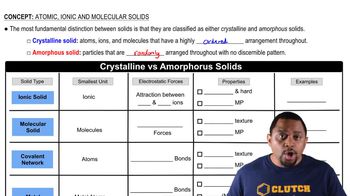
Covalent network solids are materials where atoms are bonded by a continuous network of covalent bonds, resulting in a rigid structure. These solids exhibit high melting points and are typically hard and insoluble. An example is germanium tetrachloride (GeCl4), which can form a network structure under certain conditions, contrasting with molecular compounds that consist of individual molecules.
추천 영상:
가이드 코스
 04:13
04:13Crystalline vs Amorphous Solids
관련 실천