Ch.22 - The Main Group Elements
McMurry - Chemistry 8th Edition
McMurry8th EditionChemistryISBN: 9781292336145당신이 사용하는 게 아니라요?교과서 변경
22장, 문제 133

Write a balanced net ionic equation for the reaction of the amphoteric oxide Ga2O3 with aqueous potassium hydroxide (KOH). [The product is Ga(OH)4-.]

검증된 단계별 안내
1
Identify the reactants and products in the reaction: Ga2O3 (gallium(III) oxide) and KOH (potassium hydroxide) react to form Ga(OH)4^- (tetrahydroxogallate(III) ion).
Write the balanced molecular equation for the reaction: Ga2O3 + 2 KOH + 3 H2O → 2 K^+ + 2 Ga(OH)4^-.
Separate the aqueous compounds into their respective ions: KOH dissociates into K^+ and OH^-, and Ga(OH)4^- is already in ionic form.
Identify the spectator ions: In this case, K^+ is a spectator ion because it does not participate in the formation of the product.
Write the net ionic equation by removing the spectator ions: Ga2O3 + 2 OH^- + 3 H2O → 2 Ga(OH)4^-.

주요 개념

질문에 올바르게 답하기 위해 반드시 이해해야 하는 핵심 개념들은 다음과 같습니다.

Amphoteric Oxides

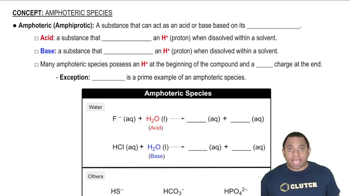
Amphoteric oxides are compounds that can react with both acids and bases. They exhibit dual behavior, meaning they can either donate protons (act as acids) or accept protons (act as bases) depending on the surrounding chemical environment. Gallium oxide (Ga2O3) is an example of an amphoteric oxide, which can react with strong bases like potassium hydroxide (KOH) to form hydroxide complexes.
추천 영상:
가이드 코스
03:03
Amphoteric Species

Net Ionic Equations

A net ionic equation represents the chemical species that are actually involved in a reaction, omitting the spectator ions that do not participate. To write a net ionic equation, one must first write the balanced molecular equation, then dissociate the soluble strong electrolytes into their ions, and finally eliminate the spectator ions to focus on the species that undergo a change during the reaction.
추천 영상:
가이드 코스
00:51
Net Ionic Equations

Complex Ion Formation

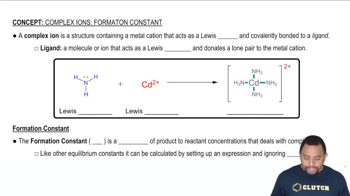
Complex ions are formed when a central metal atom or ion binds with one or more ligands, which are molecules or ions that can donate electron pairs. In this case, the reaction of Ga2O3 with KOH leads to the formation of the complex ion Ga(OH)4-. This process involves the coordination of hydroxide ions (OH-) to the gallium ion, resulting in a stable complex that can be represented in the net ionic equation.
추천 영상:
가이드 코스
02:20
Complex Ions and Formation Constant