Write an electron-dot structure for each of the following molecules or ions, and predict the geometrical structure: (a) BrO4- (b) ClO3- (c) HIO4 (d) HOBr.
검증된 단계별 안내
1
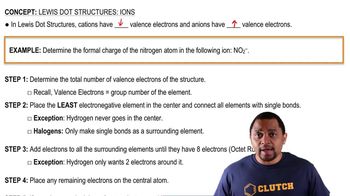
Step 1: Determine the total number of valence electrons for each molecule or ion. For ions, adjust the count by adding or subtracting electrons based on the charge.
Step 2: Write the skeletal structure of the molecule or ion, placing the least electronegative atom in the center (except for hydrogen, which is always terminal).
Step 3: Distribute the valence electrons around the atoms, starting with the outer atoms, to satisfy the octet rule (or duet for hydrogen).
Step 4: If there are remaining electrons after satisfying the octet rule for the outer atoms, place them on the central atom. If the central atom does not have a complete octet, consider forming double or triple bonds.
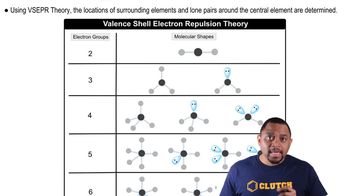
Step 5: Predict the geometrical structure using VSEPR theory by considering the number of bonding pairs and lone pairs around the central atom.
주요 개념
질문에 올바르게 답하기 위해 반드시 이해해야 하는 핵심 개념들은 다음과 같습니다.
Electron-Dot Structures
Electron-dot structures, also known as Lewis structures, represent the valence electrons of atoms within a molecule. They illustrate how electrons are shared or transferred between atoms, helping to visualize bonding and lone pairs. Understanding how to draw these structures is essential for predicting molecular geometry and reactivity.
Valence Shell Electron Pair Repulsion (VSEPR) theory is a model used to predict the geometry of molecules based on the repulsion between electron pairs around a central atom. According to VSEPR, electron pairs will arrange themselves to minimize repulsion, leading to specific shapes such as linear, trigonal planar, or tetrahedral. This theory is crucial for determining the three-dimensional arrangement of atoms in a molecule.
Formal charge is a concept used to determine the distribution of electrons in a molecule or ion. It is calculated by comparing the number of valence electrons in the free atom to the number of electrons assigned to it in the Lewis structure. Understanding formal charge helps in assessing the stability of a structure and in identifying the most favorable resonance forms.