Ch.23 - Organic and Biological Chemistry
McMurry - Chemistry 8th Edition
McMurry8th EditionChemistryISBN: 9781292336145당신이 사용하는 게 아니라요?교과서 변경
23장, 문제 23.30

Convert the following model into a condensed structure and line drawing. Draw the structures of two isomeric compounds.

검증된 단계별 안내
1
Identify the atoms and their connections in the molecular model. Each sphere represents an atom (commonly color-coded: black for carbon, white for hydrogen, blue for nitrogen, etc.), and the sticks or lines between them represent chemical bonds.
Convert the 3D molecular model into a condensed structural formula. In this formula, list each carbon atom and its directly attached atoms (including hydrogens) sequentially. For example, CH3CH2OH represents ethanol.
Draw the line-angle (or skeletal) structure from the condensed formula. In this drawing, carbon atoms are not shown explicitly; each vertex or line end represents a carbon. Hydrogen atoms bonded to carbons are also not shown unless they are necessary for clarity or are on a functional group.
Identify the functional groups and the connectivity of the atoms to determine if isomers are possible. Isomers share the same molecular formula but differ in the arrangement of atoms or the orientation of their bonds.
Draw the structures of two isomeric compounds based on the original structure. Consider structural isomers (different connectivity of atoms) and stereoisomers (same connectivity but different spatial orientation) if applicable.

비슷한 문제에 대한 검증된 영상 답변:

이 영상 해법은 위 문제에 도움이 된다고 튜터들이 추천한 것입니다.
영상 길이:
6m

주요 개념

질문에 올바르게 답하기 위해 반드시 이해해야 하는 핵심 개념들은 다음과 같습니다.

Isomerism

Isomerism refers to the phenomenon where two or more compounds have the same molecular formula but different structural arrangements or spatial orientations. These variations can lead to different physical and chemical properties. Isomers can be classified into structural isomers, which differ in the connectivity of atoms, and stereoisomers, which have the same connectivity but differ in the arrangement of atoms in space.
추천 영상:
가이드 코스
2:14
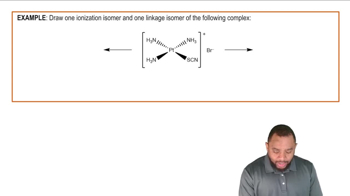
Isomerism in Coordination Complexes Example

Condensed Structures

Condensed structures are a simplified way of representing molecular structures where atoms are grouped together to show connectivity without depicting all bonds explicitly. In these representations, atoms are often written in a linear format, and hydrogen atoms attached to carbons are usually omitted for clarity. This method allows for a quick understanding of the molecular framework while maintaining essential information about the compound.
추천 영상:
가이드 코스
01:53
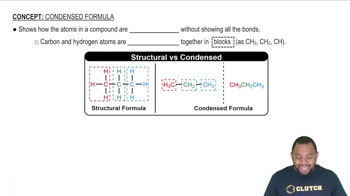
Condensed Formula

Line Drawings

Line drawings, also known as skeletal structures, are a graphical representation of organic molecules where carbon atoms are represented by the ends and intersections of lines, while other atoms, such as hydrogen, are often omitted for simplicity. Each vertex represents a carbon atom, and the lines represent bonds between them. This method is widely used in organic chemistry for its efficiency in conveying complex structures in a clear and concise manner.
추천 영상:
가이드 코스
02:33
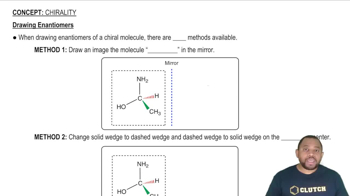
Drawing Enantiomers