Ch.23 - Organic and Biological Chemistry

McMurry8th EditionChemistryISBN: 9781292336145
당신이 사용하는 게 아니라요?교과서 변경다른 교과서를 선택하세요
TOC.tableOfContents
- Ch.1 - Chemical Tools: Experimentation & Measurement170
- Ch.2 - Atoms, Molecules & Ions160
- Ch.3 - Mass Relationships in Chemical Reactions169
- Ch.4 - Reactions in Aqueous Solution199
- Ch.5 - Periodicity & Electronic Structure of Atoms102
- Ch.6 - Ionic Compounds: Periodic Trends and Bonding Theory92
- Ch.7 - Covalent Bonding and Electron-Dot Structures61
- Ch.8 - Covalent Compounds: Bonding Theories and Molecular Structure59
- Ch.9 - Thermochemistry: Chemical Energy122
- Ch.10 - Gases: Their Properties & Behavior155
- Ch.11 - Liquids & Phase Changes54
- Ch.12 - Solids and Solid-State Materials73
- Ch.13 - Solutions & Their Properties120
- Ch.14 - Chemical Kinetics98
- Ch.15 - Chemical Equilibrium125
- Ch.16 - Aqueous Equilibria: Acids & Bases110
- Ch.17 - Applications of Aqueous Equilibria147
- Ch.18 - Thermodynamics: Entropy, Free Energy & Equilibrium86
- Ch.19 - Electrochemistry154
- Ch.20 - Nuclear Chemistry96
- Ch.21 - Transition Elements and Coordination Chemistry156
- Ch.22 - The Main Group Elements187
- Ch.23 - Organic and Biological Chemistry51

23장, 문제 86
What is a fatty acid?
 검증된 단계별 안내
1
Step 1: Understand that a fatty acid is a type of lipid, which is a large group of naturally occurring molecules that include fats, waxes, sterols, and fat-soluble vitamins.
Step 2: Recognize that fatty acids are composed of long hydrocarbon chains with a carboxylic acid group (-COOH) at one end.
Step 3: Note that the hydrocarbon chain can vary in length and can be either saturated (no double bonds between carbon atoms) or unsaturated (one or more double bonds).
Step 4: Learn that saturated fatty acids have straight chains, allowing them to pack closely together, which makes them solid at room temperature, while unsaturated fatty acids have kinks in their chains due to double bonds, making them liquid at room temperature.
Step 5: Understand that fatty acids are important in biology as they are key components of lipids, which are essential for building cell membranes and storing energy.
주요 개념
질문에 올바르게 답하기 위해 반드시 이해해야 하는 핵심 개념들은 다음과 같습니다.
Structure of Fatty Acids
Fatty acids are carboxylic acids with long hydrocarbon chains. They typically consist of a hydrophilic carboxyl group (-COOH) at one end and a hydrophobic hydrocarbon tail, which can vary in length and saturation. The structure influences their physical properties and biological functions.
추천 영상:
가이드 코스
 02:15
02:15
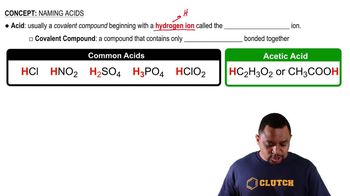
Acids and Their Structure
Saturation of Fatty Acids
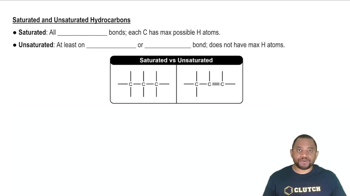
Fatty acids can be classified as saturated or unsaturated based on the presence of double bonds in their hydrocarbon chains. Saturated fatty acids have no double bonds, leading to straight chains that pack tightly, while unsaturated fatty acids contain one or more double bonds, resulting in kinks that prevent tight packing and affect melting points.
추천 영상:
가이드 코스
 02:12
02:12Saturated and Unsaturated Hydrocarbons
Biological Role of Fatty Acids
Fatty acids play crucial roles in biological systems, serving as key components of lipids, such as triglycerides and phospholipids, which are essential for cell membrane structure and energy storage. They also participate in signaling pathways and are precursors for bioactive molecules, influencing various physiological processes.
추천 영상:
가이드 코스
 01:03
01:03Binary Acids
관련 실천