Ch.23 - Organic and Biological Chemistry
McMurry - Chemistry 8th Edition
McMurry8th EditionChemistryISBN: 9781292336145당신이 사용하는 게 아니라요?교과서 변경
23장, 문제 4

What is the difference between a straight-chain alkane and a branched-chain alkane?

검증된 단계별 안내
1
Step 1: Understand the basic structure of alkanes. Alkanes are hydrocarbons with only single bonds between carbon atoms, following the general formula C_nH_{2n+2}.
Step 2: Define a straight-chain alkane. A straight-chain alkane consists of carbon atoms connected in a continuous, unbranched line. Each carbon atom (except the ends) is bonded to two other carbon atoms and enough hydrogen atoms to satisfy the tetravalency of carbon.
Step 3: Define a branched-chain alkane. A branched-chain alkane has a main chain of carbon atoms with one or more carbon atoms branching off from the main chain. These branches are also called alkyl groups.
Step 4: Compare the structures. In a straight-chain alkane, all carbon atoms are connected in a single linear sequence, whereas in a branched-chain alkane, there are one or more side chains or branches attached to the main carbon chain.
Step 5: Consider the implications of branching. Branching can affect the physical properties of alkanes, such as boiling and melting points, due to changes in molecular shape and surface area.

주요 개념

질문에 올바르게 답하기 위해 반드시 이해해야 하는 핵심 개념들은 다음과 같습니다.

Alkanes

Alkanes are saturated hydrocarbons consisting only of carbon (C) and hydrogen (H) atoms, connected by single bonds. They follow the general formula CnH2n+2, where 'n' is the number of carbon atoms. Alkanes can be classified into straight-chain and branched-chain forms based on the arrangement of their carbon atoms.
추천 영상:
가이드 코스
01:20
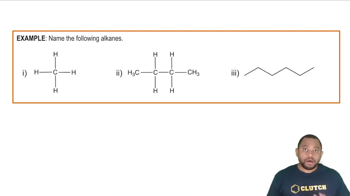
Naming Alkanes Example

Straight-Chain Alkanes

Straight-chain alkanes, also known as normal alkanes, have a linear structure where carbon atoms are connected in a continuous chain. This arrangement results in a simple, unbranched molecular structure, such as in butane (C4H10), which has four carbon atoms in a row. Their physical properties, such as boiling points, tend to increase with the length of the carbon chain.
추천 영상:
가이드 코스
02:39
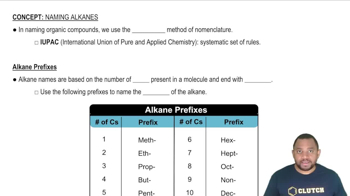
Rules for Naming Alkanes

Branched-Chain Alkanes

Branched-chain alkanes contain one or more carbon branches off the main carbon chain, leading to a more complex structure. For example, isobutane (C4H10) is a branched-chain alkane with a three-carbon chain and a single carbon branch. This branching affects the physical and chemical properties of the alkanes, often resulting in lower boiling points compared to their straight-chain counterparts.
추천 영상:
가이드 코스
02:39
Rules for Naming Alkanes