Ch.3 - Mass Relationships in Chemical Reactions
McMurry - Chemistry 8th Edition
McMurry8th EditionChemistryISBN: 9781292336145당신이 사용하는 게 아니라요?교과서 변경
3장, 문제 40c

Balance the following equations. (c) CaCN2 + H2O → CaCO3 + NH3

검증된 단계별 안내
1
Identify the number of each type of atom on both sides of the equation.
Start by balancing the atoms that appear in the fewest compounds, such as Ca and C.
Balance the nitrogen atoms by ensuring the number of NH_3 molecules matches the nitrogen atoms in CaCN_2.
Balance the hydrogen atoms by adjusting the number of H_2O molecules.
Finally, check and balance the oxygen atoms to ensure both sides of the equation have the same number.

비슷한 문제에 대한 검증된 영상 답변:

이 영상 해법은 위 문제에 도움이 된다고 튜터들이 추천한 것입니다.
영상 길이:
1m

주요 개념

질문에 올바르게 답하기 위해 반드시 이해해야 하는 핵심 개념들은 다음과 같습니다.

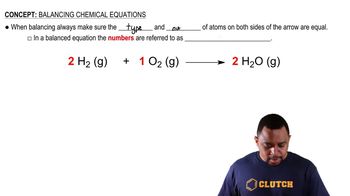
Balancing Chemical Equations

Balancing chemical equations involves ensuring that the number of atoms for each element is the same on both sides of the equation. This is based on the law of conservation of mass, which states that matter cannot be created or destroyed in a chemical reaction. Coefficients are used to adjust the quantities of reactants and products to achieve balance.
추천 영상:
가이드 코스
01:32
Balancing Chemical Equations

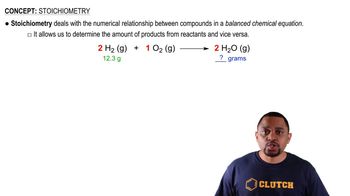
Stoichiometry

Stoichiometry is the calculation of reactants and products in chemical reactions. It allows chemists to predict the amounts of substances consumed and produced in a reaction based on balanced equations. Understanding stoichiometry is essential for determining how much of each reactant is needed and how much product can be formed.
추천 영상:
가이드 코스
01:16
Stoichiometry Concept

Types of Chemical Reactions

Chemical reactions can be classified into several types, including synthesis, decomposition, single replacement, and double replacement reactions. The reaction in the question involves a double replacement reaction, where ions exchange partners. Recognizing the type of reaction helps in predicting the products and understanding the underlying chemistry.
추천 영상:
가이드 코스
02:25
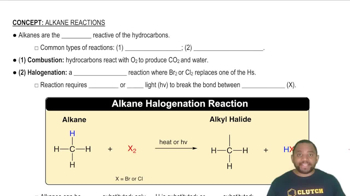
Common Types of Alkane Reactions