
Ch.3 - Mass Relationships in Chemical Reactions
McMurry - Chemistry 8th Edition
McMurry8th EditionChemistryISBN: 9781292336145당신이 사용하는 게 아니라요?교과서 변경
3장, 문제 13

Lactic acid forms in muscle tissue after strenuous exercise. Elemental analysis shows that lactic acid is 40.0% carbon, 6.71% hydrogen, and 53.3% oxygen by mass. If the molec-ular weight of lactic acid is 90.08, what is the molecular for-mula? (LO 3.11) (a) CH2O (b) C3H6O3 (c) C4H8O4 (d) C4H10O2

검증된 단계별 안내
1
Step 1: Assume that you have 100 g of the compound. This means you have 40.0 g of carbon, 6.71 g of hydrogen, and 53.3 g of oxygen.
Step 2: Convert these masses to moles using the atomic masses of the elements. The atomic masses are approximately 12.01 g/mol for carbon, 1.008 g/mol for hydrogen, and 16.00 g/mol for oxygen.
Step 3: Divide each of the obtained mole values by the smallest one among them to get the ratio of the atoms. This will give you the empirical formula.
Step 4: Calculate the molar mass of the empirical formula. If it matches the given molecular weight, then the empirical formula is the same as the molecular formula.
Step 5: If the molar mass of the empirical formula is less than the given molecular weight, find the factor by which they differ. Multiply the subscripts in the empirical formula by this factor to get the molecular formula.

비슷한 문제에 대한 검증된 영상 답변:

이 영상 해법은 위 문제에 도움이 된다고 튜터들이 추천한 것입니다.
영상 길이:
5m
도움이 되었나요?

주요 개념

질문에 올바르게 답하기 위해 반드시 이해해야 하는 핵심 개념들은 다음과 같습니다.

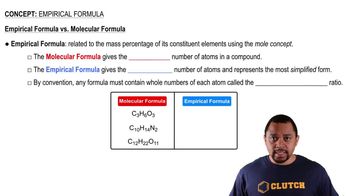
Empirical Formula

The empirical formula represents the simplest whole-number ratio of the elements in a compound. To determine it, the percentage composition of each element is converted to moles, and the resulting mole ratios are simplified. In the case of lactic acid, the empirical formula can be derived from the given mass percentages of carbon, hydrogen, and oxygen.
추천 영상:
가이드 코스
02:26
Empirical vs Molecular Formula

Molecular Weight

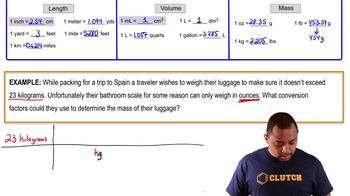
Molecular weight is the sum of the atomic weights of all atoms in a molecule, typically expressed in grams per mole (g/mol). It is crucial for determining the molecular formula, as the molecular formula is a whole-number multiple of the empirical formula. In this question, the molecular weight of lactic acid is given as 90.08 g/mol, which will be used to find the correct molecular formula.
추천 영상:
가이드 코스
03:45
Weight Conversion Example

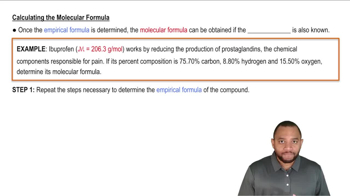
Molecular Formula Calculation

The molecular formula is derived from the empirical formula by multiplying it by a whole number that reflects how many times the empirical formula fits into the molecular weight. After determining the empirical formula from the mass percentages, the ratio of the molecular weight to the empirical formula weight is calculated to find this multiplier, allowing for the identification of the correct molecular formula for lactic acid.
추천 영상:
가이드 코스
6:53
Molecular Formula Calculation Example