

Ch.3 - Mass Relationships in Chemical Reactions
McMurry - Chemistry 8th Edition
McMurry8th EditionChemistryISBN: 9781292336145당신이 사용하는 게 아니라요?교과서 변경
3장, 문제 34

What is the difference between a covalent bond and an ionic bond?

검증된 단계별 안내
1
Understand that atoms bond together to form molecules and compounds, and the nature of the bond depends on how they share or transfer electrons.
Recognize that a covalent bond involves the sharing of electrons between atoms. This type of bond typically forms between nonmetal atoms with similar electronegativities.
Identify that an ionic bond involves the transfer of electrons from one atom to another, leading to the formation of ions. This type of bond usually occurs between metal and nonmetal atoms, where the metal loses electrons to become a positively charged cation and the nonmetal gains electrons to become a negatively charged anion.
Note that the resulting electrostatic attraction between oppositely charged ions forms the ionic bond, which is generally stronger and has higher melting and boiling points compared to covalent bonds.
Consider the properties of substances based on the type of bonding. Ionic compounds typically dissolve in water and conduct electricity when molten or in solution, whereas covalent compounds may not dissolve in water and usually do not conduct electricity.

비슷한 문제에 대한 검증된 영상 답변:

이 영상 해법은 위 문제에 도움이 된다고 튜터들이 추천한 것입니다.
영상 길이:
1m
도움이 되었나요?

주요 개념

질문에 올바르게 답하기 위해 반드시 이해해야 하는 핵심 개념들은 다음과 같습니다.

Covalent Bonding

Covalent bonding occurs when two atoms share one or more pairs of electrons, allowing each atom to attain a stable electron configuration. This type of bond typically forms between nonmetals, where the shared electrons enable both atoms to achieve full outer shells, resulting in the formation of molecules. An example of a covalent bond is the bond between two hydrogen atoms in a hydrogen molecule (H2).
추천 영상:

Ionic Bonding

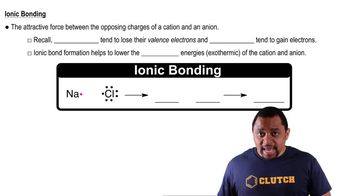
Ionic bonding is the electrostatic attraction between positively charged ions (cations) and negatively charged ions (anions). This bond forms when one atom donates an electron to another, resulting in the formation of charged ions. Ionic bonds typically occur between metals and nonmetals, such as sodium (Na) and chlorine (Cl) in sodium chloride (NaCl), where sodium loses an electron and chlorine gains one.
추천 영상:

Electronegativity

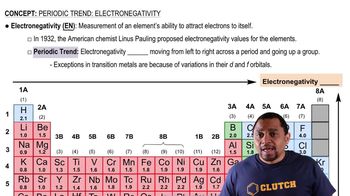
Electronegativity is a measure of an atom's ability to attract and hold onto electrons in a chemical bond. In covalent bonds, atoms with similar electronegativities share electrons equally, while in ionic bonds, a significant difference in electronegativity leads to the complete transfer of electrons from one atom to another. Understanding electronegativity helps predict the type of bond that will form between two elements.
추천 영상:
가이드 코스
02:10
Electronegativity Trends
관련 실천