
Ch.4 - Reactions in Aqueous Solution
McMurry - Chemistry 8th Edition
McMurry8th EditionChemistryISBN: 9781292336145당신이 사용하는 게 아니라요?교과서 변경
4장, 문제 150a

A 1.268 g sample of a metal carbonate (MCO3) was treated with 100.00 mL of 0.1083 M sulfuric acid (H2SO4), yielding CO2 gas and an aqueous solution of the metal sulfate (MSO4). The solution was boiled to remove all the dissolved CO2 and was then titrated with 0.1241 M NaOH. A 71.02 mL volume of NaOH was required to neutralize the excess H2SO4. (a) What is the identity of the metal M?

검증된 단계별 안내
1
Determine the moles of H2SO4 initially added to the reaction by using the concentration and volume of the sulfuric acid solution. Use the formula: Moles = Molarity × Volume (in liters).
Calculate the moles of NaOH used in the titration using its molarity and the volume used. Again, use the formula: Moles = Molarity × Volume (in liters).
Since NaOH neutralizes the excess H2SO4, calculate the moles of H2SO4 that reacted with the metal carbonate by subtracting the moles of NaOH from the moles of H2SO4 initially added.
Write the balanced chemical equation for the reaction between the metal carbonate (MCO3) and sulfuric acid (H2SO4) to form metal sulfate (MSO4), water (H2O), and carbon dioxide (CO2). From the stoichiometry of the reaction, determine the moles of MCO3 that reacted.
Calculate the molar mass of the metal carbonate (MCO3) using the mass of the sample and the moles of MCO3. Then, subtract the molar mass of CO3 (60.01 g/mol) from the molar mass of MCO3 to find the atomic mass of the metal M, which helps identify the metal.

비슷한 문제에 대한 검증된 영상 답변:

이 영상 해법은 위 문제에 도움이 된다고 튜터들이 추천한 것입니다.
영상 길이:
10m

주요 개념

질문에 올바르게 답하기 위해 반드시 이해해야 하는 핵심 개념들은 다음과 같습니다.

Stoichiometry

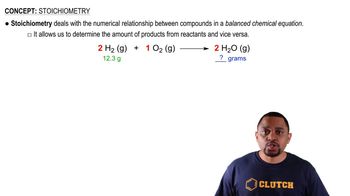
Stoichiometry is the calculation of reactants and products in chemical reactions based on the balanced chemical equation. It allows us to determine the relationships between the quantities of substances involved in a reaction. In this question, stoichiometry is essential for relating the amount of sulfuric acid used to the amount of metal carbonate that reacted, ultimately helping to identify the metal.
추천 영상:
가이드 코스
01:16
Stoichiometry Concept

Acid-Base Reactions

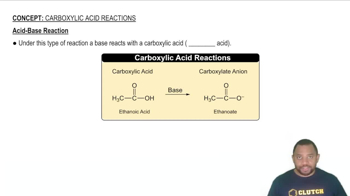
Acid-base reactions involve the transfer of protons (H+) between reactants, typically resulting in the formation of water and a salt. In this scenario, sulfuric acid reacts with the metal carbonate to produce carbon dioxide and a metal sulfate. Understanding the nature of these reactions is crucial for determining how much acid was neutralized by the base, which is key to identifying the metal.
추천 영상:
가이드 코스
01:09
Acid-Base Reaction

Titration

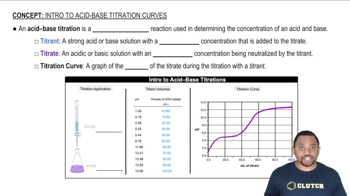
Titration is a quantitative analytical technique used to determine the concentration of a solute in a solution. It involves the gradual addition of a titrant to a solution until a reaction reaches completion, indicated by a color change or pH change. In this question, the titration of the remaining sulfuric acid with NaOH provides critical data to calculate the amount of acid that reacted, which is necessary for identifying the metal in the carbonate.
추천 영상:
가이드 코스
03:04
Acid-Base Titration
관련 실천
교과서 질문
Salicylic acid, used in the manufacture of aspirin, contains only the elements C, H, and O and has only one acidic hydrogen that reacts with NaOH. When 1.00 g of salicylic acid undergoes complete combustion, 2.23 g CO2 and 0.39 g H2O are obtained. When 1.00 g of salicylic acid is titrated with 0.100 M NaOH, 72.4 mL of base is needed for complete reaction. What are the empirical and molecular formulas of salicylic acid?
1105
views
교과서 질문

Compound X contains only the elements C, H, O, and S. A 5.00 g sample undergoes complete combustion to give 4.83 g of CO2, 1.48 g of H2O, and a certain amount of SO2 that is further oxidized to SO3 and dissolved in water to form sulfuric acid, H2SO4. On titration of the H2SO4, 109.8 mL of 1.00 M NaOH is needed for complete reaction. (Both H atoms in sulfuric acid are acidic and react with NaOH.) (a) What is the empirical formula of X?

628
views
교과서 질문

Element M is prepared industrially by a two-step procedure according to the following (unbalanced) equations:

Assume that 0.855 g of M2O3 is submitted to the reaction sequence. When the HCl produced in step (2) is dissolved in water and titrated with 0.511 M NaOH, 144.2 mL of the NaOH solution is required to neutralize the HCl. (a) Balance both equations.

455
views
교과서 질문
Assume that you dissolve 10.0 g of a mixture of NaOH and Ba(OH)2 in 250.0 mL of water and titrate with 1.50 M hydrochloric acid. The titration is complete after 108.9 mL of the acid has been added. What is the mass in grams of each substance in the mixture?
1062
views
교과서 질문

(b) How many liters of CO2 gas were produced if the density of CO2 is 1.799 g/L?

719
views
교과서 질문

(b) When 5.00 g of X is titrated with NaOH, it is found that X has two acidic hydrogens that react with NaOH and that 54.9 mL of 1.00 M NaOH is required to completely neu-tralize the sample. What is the molecular formula of X?

434
views