Ch.4 - Reactions in Aqueous Solution
McMurry - Chemistry 8th Edition
McMurry8th EditionChemistryISBN: 9781292336145당신이 사용하는 게 아니라요?교과서 변경
4장, 문제 110d

Assign oxidation numbers to each element in the following ions. (d) NO2-

검증된 단계별 안내
1
Identify the overall charge of the ion, which is -1 for NO_2^-.
Assign the oxidation number of oxygen as -2, which is typical for oxygen in most compounds.
Let the oxidation number of nitrogen be x.
Set up the equation based on the sum of oxidation numbers: x + 2(-2) = -1.
Solve the equation for x to find the oxidation number of nitrogen.

비슷한 문제에 대한 검증된 영상 답변:

이 영상 해법은 위 문제에 도움이 된다고 튜터들이 추천한 것입니다.
영상 길이:
3m
도움이 되었나요?

주요 개념

질문에 올바르게 답하기 위해 반드시 이해해야 하는 핵심 개념들은 다음과 같습니다.

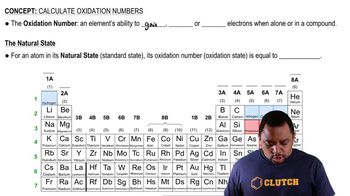
Oxidation Numbers

Oxidation numbers are a way to keep track of electron transfer in chemical reactions. They represent the hypothetical charge an atom would have if all bonds were ionic. The rules for assigning oxidation numbers include that the oxidation number of an element in its elemental form is zero, and for monoatomic ions, it equals the charge of the ion.
추천 영상:
가이드 코스
02:42
Oxidation Numbers

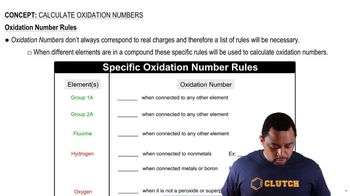
Rules for Assigning Oxidation Numbers

There are specific rules for assigning oxidation numbers, such as oxygen typically having an oxidation number of -2, hydrogen being +1 when bonded to non-metals, and the sum of oxidation numbers in a neutral compound being zero or equal to the charge in a polyatomic ion. These rules help in determining the oxidation states of elements in compounds and ions.
추천 영상:
가이드 코스
03:13
Oxidation Number Rules

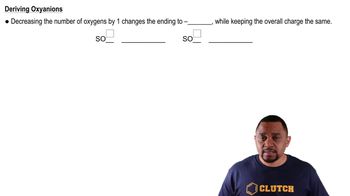
Polyatomic Ions

Polyatomic ions are ions composed of two or more atoms that are covalently bonded and carry a net charge. In the case of the nitrite ion (NO2-), it consists of one nitrogen atom and two oxygen atoms, with an overall charge of -1. Understanding the structure and charge of polyatomic ions is essential for correctly assigning oxidation numbers to their constituent elements.
추천 영상:
가이드 코스
01:20
Polyatomic Ion Variations