Ch.4 - Reactions in Aqueous Solution
McMurry - Chemistry 8th Edition
McMurry8th EditionChemistryISBN: 9781292336145당신이 사용하는 게 아니라요?교과서 변경
4장, 문제 88

Assume that you have an aqueous solution of an unknown salt. Treatment of the solution with dilute NaOH, Na2SO4, and KCl produces no precipitate. Which of the following cations might the solution contain? (a) Ag+ (b) Cs+ (c) Ba2+ (d) NH4 +

검증된 단계별 안내
1
First, let's understand the concept of precipitation reactions. These are reactions that occur when two soluble salts in aqueous solution combine to form a salt that is insoluble in water, or a precipitate.
Next, let's consider the given information. The unknown salt does not form a precipitate when treated with NaOH, Na2SO4, and KCl. This means that the cation in the unknown salt does not form an insoluble compound with OH-, SO4^2-, or Cl- ions.
Let's analyze each of the given cations: (a) Ag+ would form a precipitate with Cl- (AgCl is insoluble in water), (b) Cs+ does not form a precipitate with any of the anions, (c) Ba2+ would form a precipitate with SO4^2- (BaSO4 is insoluble in water), and (d) NH4+ does not form a precipitate with any of the anions.
From the above analysis, we can see that the cations that do not form a precipitate with OH-, SO4^2-, or Cl- ions are Cs+ and NH4+.
Therefore, the unknown salt could contain either Cs+ or NH4+ cations.

비슷한 문제에 대한 검증된 영상 답변:

이 영상 해법은 위 문제에 도움이 된다고 튜터들이 추천한 것입니다.
영상 길이:
2m

주요 개념

질문에 올바르게 답하기 위해 반드시 이해해야 하는 핵심 개념들은 다음과 같습니다.

Solubility Rules

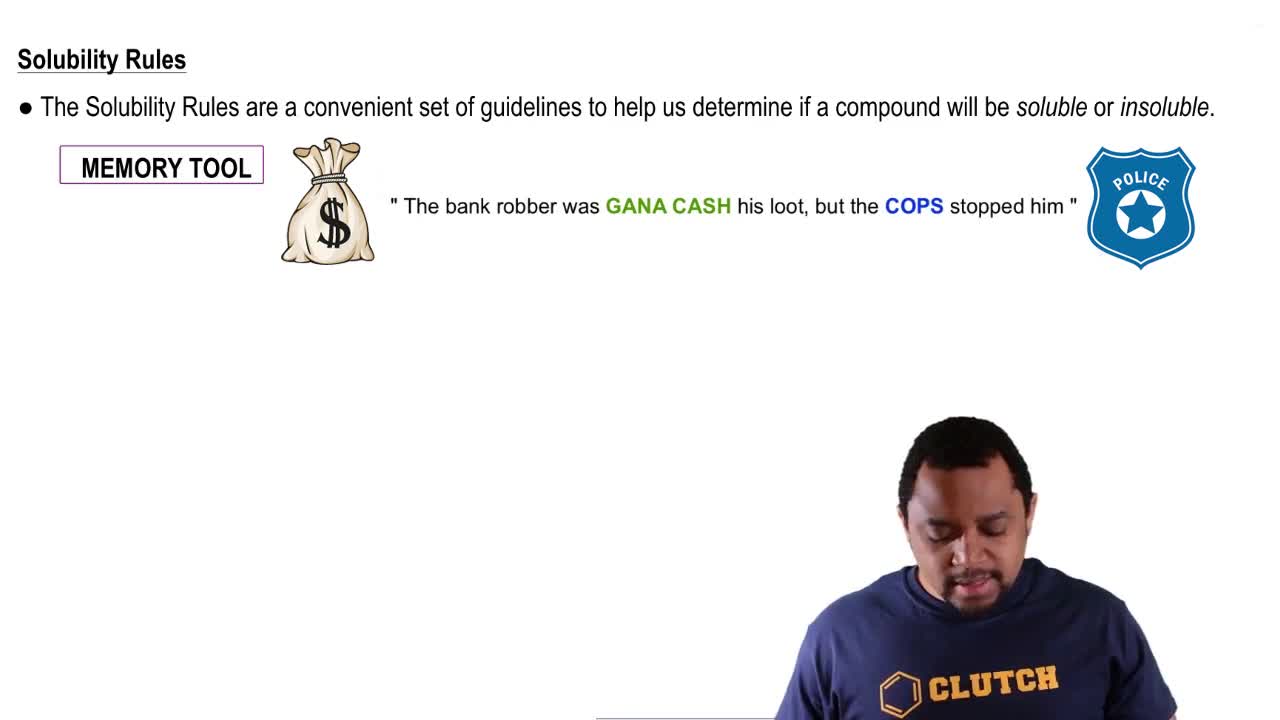
Solubility rules are guidelines that predict the solubility of various ionic compounds in water. For instance, most alkali metal salts, such as those containing Na+ or K+, are soluble, while certain cations like Ag+ and Ba2+ can form insoluble precipitates with specific anions. Understanding these rules helps determine which cations can remain in solution when treated with different reagents.
추천 영상:
가이드 코스
00:28
Solubility Rules

Precipitation Reactions

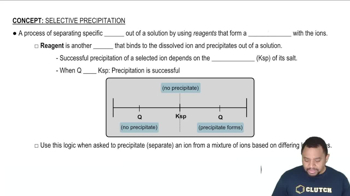
Precipitation reactions occur when two soluble salts react in solution to form an insoluble compound, or precipitate. The formation of a precipitate is indicated by cloudiness or solid formation in the solution. In this question, the absence of precipitate upon treatment with NaOH, Na2SO4, and KCl suggests that the cations present do not form insoluble compounds with these anions.
추천 영상:
가이드 코스
01:53
Selective Precipitation

Common Cations and Their Behavior

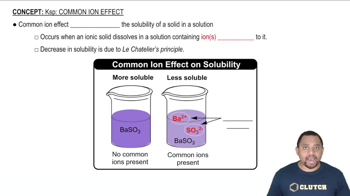
Different cations exhibit distinct behaviors in aqueous solutions based on their chemical properties. For example, NH4+ is typically soluble and does not form precipitates with the tested reagents, while Ag+ can form precipitates with halides and hydroxides. Recognizing the behavior of common cations helps in predicting which ions can coexist in solution without forming precipitates.
추천 영상:
가이드 코스
02:53
Common Ion Effect