Ch.4 - Reactions in Aqueous Solution
McMurry - Chemistry 8th Edition
McMurry8th EditionChemistryISBN: 9781292336145당신이 사용하는 게 아니라요?교과서 변경
4장, 문제 49

How many milliliters of a 0.350 M KOH solution contain 0.0171 mol of KOH?

검증된 단계별 안내
1
Identify the relationship between moles, molarity, and volume using the formula: \( M = \frac{n}{V} \), where \( M \) is molarity, \( n \) is the number of moles, and \( V \) is the volume in liters.
Rearrange the formula to solve for volume: \( V = \frac{n}{M} \).
Substitute the given values into the equation: \( n = 0.0171 \text{ mol} \) and \( M = 0.350 \text{ M} \).
Calculate the volume in liters using the rearranged formula.
Convert the volume from liters to milliliters by multiplying by 1000, since 1 liter = 1000 milliliters.

비슷한 문제에 대한 검증된 영상 답변:

이 영상 해법은 위 문제에 도움이 된다고 튜터들이 추천한 것입니다.
영상 길이:
1m

주요 개념

질문에 올바르게 답하기 위해 반드시 이해해야 하는 핵심 개념들은 다음과 같습니다.

Molarity (M)

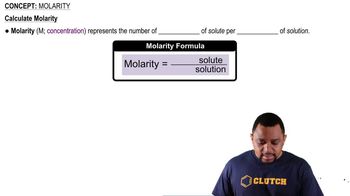
Molarity is a measure of concentration defined as the number of moles of solute per liter of solution. It is expressed in moles per liter (mol/L). Understanding molarity is essential for calculating the volume of a solution needed to achieve a specific number of moles of solute.
추천 영상:
가이드 코스
00:53
Molarity Concept

Stoichiometry

Stoichiometry involves the calculation of reactants and products in chemical reactions. It allows us to relate the amounts of substances involved in a reaction based on their molar ratios. In this context, stoichiometry helps determine how much volume of a solution is required to provide a certain number of moles of solute.
추천 영상:
가이드 코스
01:16
Stoichiometry Concept

Volume Calculation

Volume calculation in chemistry often involves using the formula: Volume (L) = Moles of solute / Molarity. This formula allows us to find the volume of a solution needed to contain a specific number of moles of solute, which is crucial for preparing solutions in laboratory settings.
추천 영상:
가이드 코스
02:35
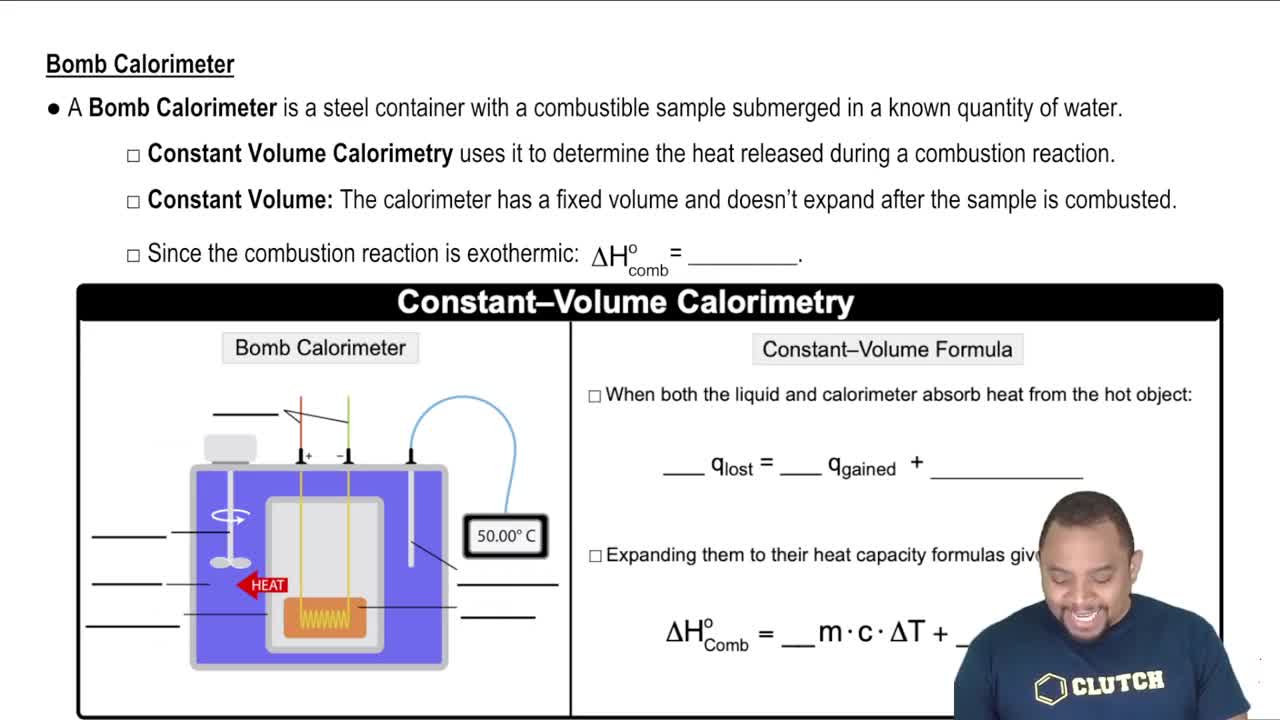
Constant-Volume Calorimetry