Ch.4 - Reactions in Aqueous Solution
McMurry - Chemistry 8th Edition
McMurry8th EditionChemistryISBN: 9781292336145당신이 사용하는 게 아니라요?교과서 변경
4장, 문제 63

The following aqueous solutions were tested with a light bulb conductivity apparatus, as shown in Figure 4.3. What result—dark, dim, or bright—do you expect from each? (a) 0.10 M hydrofluoric acid (b) 0.10 M sodium chloride (c) 0.10 M glucose (C6H12O6)

검증된 단계별 안내
1
Identify the type of each compound: (a) hydrofluoric acid (HF) is a weak acid, (b) sodium chloride (NaCl) is a strong electrolyte, and (c) glucose (C6H12O6) is a non-electrolyte.
Understand the relationship between the type of compound and its conductivity: strong electrolytes fully dissociate in water, weak electrolytes partially dissociate, and non-electrolytes do not dissociate.
Predict the conductivity for each solution: (a) HF will produce a dim light because it partially dissociates, (b) NaCl will produce a bright light because it fully dissociates, and (c) glucose will produce a dark light because it does not dissociate.
Consider the concentration of each solution: all solutions are 0.10 M, which means the concentration is the same, so the differences in conductivity are due to the nature of the solute.
Summarize the expected results: (a) dim light for HF, (b) bright light for NaCl, and (c) dark light for glucose.

비슷한 문제에 대한 검증된 영상 답변:

이 영상 해법은 위 문제에 도움이 된다고 튜터들이 추천한 것입니다.
영상 길이:
2m
도움이 되었나요?

주요 개념

질문에 올바르게 답하기 위해 반드시 이해해야 하는 핵심 개념들은 다음과 같습니다.

Electrolytes and Nonelectrolytes

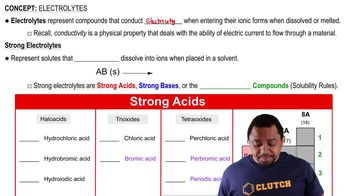
Electrolytes are substances that dissociate into ions when dissolved in water, allowing the solution to conduct electricity. Strong electrolytes, like sodium chloride, fully dissociate into ions, while weak electrolytes, such as hydrofluoric acid, only partially dissociate. Nonelectrolytes, like glucose, do not produce ions in solution and therefore do not conduct electricity.
추천 영상:
가이드 코스
02:50
Electrolytes and Strong Acids

Conductivity in Solutions

The conductivity of a solution is determined by the presence and concentration of ions. A bright light bulb indicates a high concentration of ions, resulting in strong conductivity, while a dim light suggests fewer ions. A dark result means no significant ion presence, indicating poor or no conductivity.
추천 영상:
가이드 코스
01:39
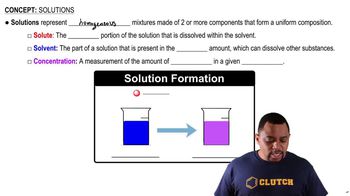
Solution Components

Concentration and Ionization

The concentration of a solute affects the number of ions available for conductivity. In the case of 0.10 M solutions, the degree of ionization is crucial; strong electrolytes like sodium chloride will fully ionize, while weak acids like hydrofluoric acid will only partially ionize, leading to different conductivity outcomes. Glucose, being a nonelectrolyte, will not contribute to conductivity regardless of its concentration.
추천 영상:
가이드 코스
02:22
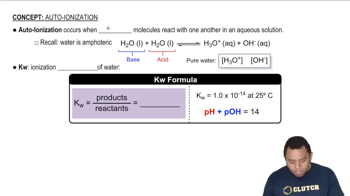
Auto-Ionization and Kw