How could you use a precipitation reaction to separate each of the following pairs of cations? Write the formula for each reactant you would add, and write a balanced net ionic equation for each reaction. (b)
Ch.4 - Reactions in Aqueous Solution
4장, 문제 92b
The following three solutions are mixed: 100.0 mL of 0.100 M Na2SO4, 50.0 mL of 0.300 M ZnCl2, and 100.0 mL of 0.200 M Ba(CN)2. (b) What is the molarity of each ion remaining in the solution assuming complete precipitation of all insoluble compounds?
검증된 단계별 안내1
Calculate the initial moles of each ion in the solutions. For Na2SO4, use the formula: moles = molarity \(\times\) volume (in liters). Do the same for ZnCl2 and Ba(CN)2.
Write down the possible precipitation reactions that could occur based on the ions present in the solutions. Consider the solubility rules to determine which compounds are likely to precipitate.
For each potential precipitate, use the stoichiometry of the reaction to determine how many moles of each ion would be needed to form the precipitate. Compare this to the moles available in the solution to find the limiting reactant.
Subtract the moles of ions that precipitate from the initial moles to find the moles of each ion remaining in the solution.
Calculate the final molarity of each ion by dividing the remaining moles of each ion by the total volume of the solution in liters.

비슷한 문제에 대한 검증된 영상 답변:
이 영상 해법은 위 문제에 도움이 된다고 튜터들이 추천한 것입니다.
영상 길이:
12m주요 개념
질문에 올바르게 답하기 위해 반드시 이해해야 하는 핵심 개념들은 다음과 같습니다.
Molarity
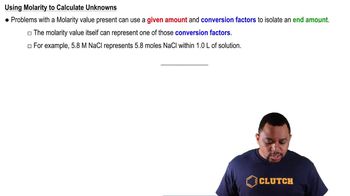
Molarity is a measure of concentration defined as the number of moles of solute per liter of solution. It is expressed in moles per liter (M) and is crucial for calculating the amounts of ions present in a solution after mixing different solutions. Understanding molarity allows for the determination of how much of each ion will remain in the solution after any reactions, such as precipitation.
추천 영상:
가이드 코스
Molarity
Precipitation Reactions
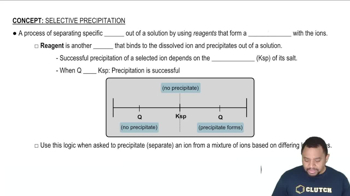
Precipitation reactions occur when two soluble salts react in solution to form an insoluble compound, or precipitate. This process is essential in the context of the question, as it determines which ions will remain in solution and which will form solid precipitates. Identifying the solubility rules helps predict the formation of precipitates and the resulting concentrations of ions in the final solution.
추천 영상:
가이드 코스
Selective Precipitation
Stoichiometry
Stoichiometry involves the calculation of reactants and products in chemical reactions based on balanced chemical equations. It is vital for determining the amounts of ions produced or consumed during reactions, including precipitation. By applying stoichiometric principles, one can calculate the remaining concentrations of ions after the complete precipitation of insoluble compounds in the mixed solutions.
추천 영상:
가이드 코스
Stoichiometry Concept
관련 실천
교과서 질문
557
views
교과서 질문
Assume that you are given a solution of an unknown acid or base. How can you tell whether the unknown substance is acidic or basic?
384
views
교과서 질문
The following three solutions are mixed: 100.0 mL of 0.100 M Na2SO4, 50.0 mL of 0.300 M ZnCl2, and 100.0 mL of 0.200 M Ba(CN)2. (a) What ionic compounds will precipitate out of solution?
638
views
교과서 질문
(b) What is the mass of each substance in the original 250 g mixture?
578
views
교과서 질문
How could you use a precipitation reaction to separate each of the following pairs of anions? Write the formula for each reactant you would add, and write a balanced net ionic equation for each reaction.
(a)
761
views
교과서 질문
A 250.0 g sample of a white solid is known to be a mixture of KNO3, BaCl2, and NaCl. When 100.0 g of this mixture is dis-solved in water and allowed to react with excess H2SO4, 67.3 g of a white precipitate is collected. When the remaining 150.0 g of the mixture is dissolved in water and allowed to react with excess AgNO3, 197.6 g of a second precipitate is collected. (a) What are the formulas of the two precipitates?
470
views