Ch.5 - Periodicity & Electronic Structure of Atoms
McMurry - Chemistry 8th Edition
McMurry8th EditionChemistryISBN: 9781292336145당신이 사용하는 게 아니라요?교과서 변경
5장, 문제 111b

Given the subshells 1s, 2s, 2p, 3s, 3p and 3d, identify those that meet the following descriptions. (b) Can have ml = -1

검증된 단계별 안내
1
Step 1: Understand that the magnetic quantum number (ml) describes the specific orbital within a subshell where an electron is likely to be found. It can have values ranging from -l to +l, where l is the azimuthal quantum number (also known as the orbital quantum number or angular momentum quantum number).
Step 2: Recall that the azimuthal quantum number (l) for a subshell is determined by the type of the subshell: s subshells have l=0, p subshells have l=1, d subshells have l=2, and so on.
Step 3: Since ml can range from -l to +l, a subshell can have ml = -1 if its azimuthal quantum number l is 1 or greater.
Step 4: From the given subshells, identify those with l=1 or greater. These are the 2p, 3p, and 3d subshells.
Step 5: Therefore, the subshells that can have ml = -1 are the 2p, 3p, and 3d subshells.

비슷한 문제에 대한 검증된 영상 답변:

이 영상 해법은 위 문제에 도움이 된다고 튜터들이 추천한 것입니다.
영상 길이:
3m
도움이 되었나요?

주요 개념

질문에 올바르게 답하기 위해 반드시 이해해야 하는 핵심 개념들은 다음과 같습니다.

Quantum Numbers

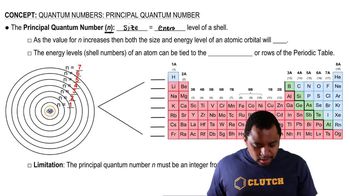
Quantum numbers are a set of numerical values that describe the unique quantum state of an electron in an atom. The four quantum numbers include the principal quantum number (n), azimuthal quantum number (l), magnetic quantum number (ml), and spin quantum number (ms). Each number provides specific information about the electron's energy level, shape, orientation, and spin.
추천 영상:
가이드 코스
02:55
Principal Quantum Number

Magnetic Quantum Number (ml)

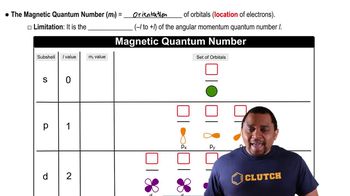
The magnetic quantum number (ml) determines the orientation of an orbital in space and can take on integer values ranging from -l to +l, where l is the azimuthal quantum number. For example, if l = 1 (p subshell), ml can be -1, 0, or +1. This concept is crucial for understanding how orbitals are arranged in a magnetic field and how they interact with other orbitals.
추천 영상:
가이드 코스
03:06
Magnetic Quantum Number

Subshells and Their Designations

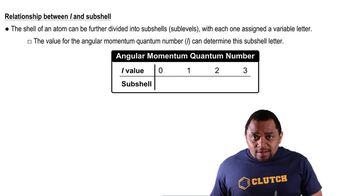
Subshells are divisions of electron shells that contain orbitals of the same type. They are designated by the letters s, p, d, and f, corresponding to different values of l (0, 1, 2, and 3, respectively). In this context, the 2p subshell has l = 1, allowing for ml values of -1, 0, and +1, while the 3p subshell also allows ml = -1, making them relevant to the question.
추천 영상:
가이드 코스
01:02
Angular Momentum Quantum Number and Subshell