
Ch.5 - Periodicity & Electronic Structure of Atoms
McMurry - Chemistry 8th Edition
McMurry8th EditionChemistryISBN: 9781292336145당신이 사용하는 게 아니라요?교과서 변경
5장, 문제 104

Give the expected ground-state electron configurations for the following elements: (a) Ti (b) Ru (c) Sn (d) Sr (e) Se.

검증된 단계별 안내
1
Step 1: Understand the concept of electron configuration, which describes the distribution of electrons in an atom's orbitals. The order of filling is based on the Aufbau principle, which states that electrons fill orbitals starting from the lowest energy level to the highest.
Step 2: Use the periodic table to determine the atomic number of each element, which indicates the number of electrons in a neutral atom. For example, Ti has an atomic number of 22, Ru has 44, Sn has 50, Sr has 38, and Se has 34.
Step 3: Apply the order of filling orbitals: 1s, 2s, 2p, 3s, 3p, 4s, 3d, 4p, 5s, 4d, 5p, 6s, 4f, 5d, 6p, 7s, 5f, 6d, 7p. Remember that the 3d orbitals are filled after the 4s orbital, and the 4d orbitals are filled after the 5s orbital.
Step 4: Write the electron configuration for each element by filling the orbitals in the order determined in Step 3, ensuring the total number of electrons matches the atomic number of the element. For example, for Ti, fill up to 3d² after 4s².
Step 5: Check for any exceptions to the expected order of filling, particularly in transition metals and heavier elements, where electron configurations may differ slightly due to electron-electron interactions and energy considerations.

주요 개념

질문에 올바르게 답하기 위해 반드시 이해해야 하는 핵심 개념들은 다음과 같습니다.

Electron Configuration

Electron configuration describes the distribution of electrons in an atom's orbitals. It follows the Aufbau principle, which states that electrons fill orbitals starting from the lowest energy level to the highest. The notation typically includes the principal quantum number, the type of orbital (s, p, d, f), and the number of electrons in that orbital, providing a complete picture of an atom's electronic structure.
추천 영상:
가이드 코스
01:33
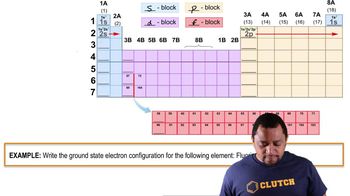
Electron Configuration Example

Periodic Table and Electron Shells

The periodic table organizes elements based on their atomic number and electron configurations. Elements in the same group have similar valence electron configurations, which influence their chemical properties. Understanding the arrangement of elements helps predict the electron configuration based on their position in the table, particularly for transition metals and post-transition metals.
추천 영상:
가이드 코스
00:46
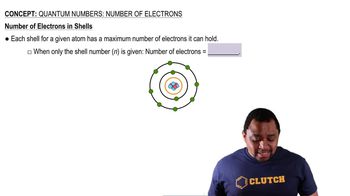
Number of Electrons in Shells

Exceptions to Electron Configuration

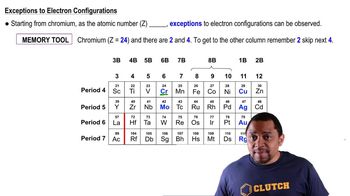
Certain elements, particularly transition metals, exhibit exceptions to the expected electron configurations due to electron-electron interactions and stability considerations. For example, elements like chromium and copper have configurations that involve the promotion of electrons to achieve half-filled or fully filled d orbitals, which provide additional stability. Recognizing these exceptions is crucial for accurately determining the ground-state configurations of specific elements.
추천 영상:
가이드 코스
01:15
Electron Configuration Exceptions