Ch.5 - Periodicity & Electronic Structure of Atoms
McMurry - Chemistry 8th Edition
McMurry8th EditionChemistryISBN: 9781292336145당신이 사용하는 게 아니라요?교과서 변경
5장, 문제 79

Give the orbital designations of electrons with the following quantum numbers. (a) n = 3, l = 0, ml = 0 (b) n = 2, l = 1, ml = -1 (c) n = 4, l = 3, ml = -2 (d) n = 4, l = 2, ml = 0

검증된 단계별 안내
1
Identify the principal quantum number (n) which indicates the energy level of the electron.
Determine the azimuthal quantum number (l) which indicates the shape of the orbital. Use the values: l = 0 (s), l = 1 (p), l = 2 (d), l = 3 (f).
Use the magnetic quantum number (ml) to determine the orientation of the orbital in space. It ranges from -l to +l.
Combine the values of n and l to designate the type of orbital (e.g., 3s, 2p, 4f, etc.).
For each set of quantum numbers, write the orbital designation by combining the principal quantum number and the letter corresponding to the azimuthal quantum number.

비슷한 문제에 대한 검증된 영상 답변:

이 영상 해법은 위 문제에 도움이 된다고 튜터들이 추천한 것입니다.
영상 길이:
1m

주요 개념

질문에 올바르게 답하기 위해 반드시 이해해야 하는 핵심 개념들은 다음과 같습니다.

Quantum Numbers

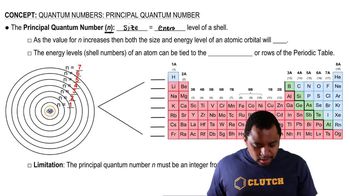
Quantum numbers are a set of four numbers that describe the unique quantum state of an electron in an atom. They include the principal quantum number (n), which indicates the energy level; the azimuthal quantum number (l), which defines the subshell; the magnetic quantum number (ml), which specifies the orientation of the orbital; and the spin quantum number (ms), which describes the electron's spin. Understanding these numbers is essential for determining the electron's location and energy.
추천 영상:
가이드 코스
02:55
Principal Quantum Number

Orbital Designation

Orbital designations are labels that describe the shape and type of atomic orbitals where electrons reside. The designation is derived from the quantum numbers, particularly n and l. For example, when l = 0, the orbital is an 's' orbital; when l = 1, it is a 'p' orbital; when l = 2, it is a 'd' orbital; and when l = 3, it is an 'f' orbital. This classification helps in visualizing electron distribution in an atom.
추천 영상:
가이드 코스
03:06
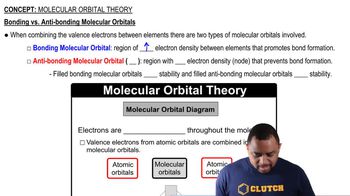
Molecular Orbital Theory

Electron Configuration

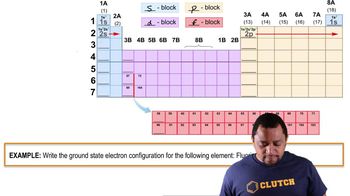
Electron configuration refers to the arrangement of electrons in an atom's orbitals, which is determined by the quantum numbers. It follows specific rules, such as the Aufbau principle, Pauli exclusion principle, and Hund's rule, to ensure that electrons fill the lowest energy orbitals first. Understanding electron configuration is crucial for predicting chemical behavior, bonding, and the properties of elements.
추천 영상:
가이드 코스
01:33
Electron Configuration Example