
Draw orbital-filling diagrams for atoms with the following atomic numbers. Show each electron as an up or down arrow, and use the abbreviation of the preceding noble gas to represent inner-shell electrons. (a) Z = 25 (b) Z = 56 (c) Z = 28 (d) Z = 47
Ch.5 - Periodicity & Electronic Structure of Atoms
5장, 문제 109
Identify the following atoms: (a) It has the ground-state electron configuration [Ar] 4s2 3d10 4p1.
검증된 단계별 안내1
Step 1: Understand the electron configuration notation. The notation [Ar] 4s^2 3d^10 4p^1 indicates that the atom has the same electron configuration as Argon (Ar) up to the 3p^6 level, and then additional electrons are added in the 4s, 3d, and 4p orbitals.
Step 2: Count the total number of electrons. Argon has 18 electrons. The additional electrons in 4s^2, 3d^10, and 4p^1 are 2 + 10 + 1 = 13 electrons. Therefore, the total number of electrons is 18 (from Argon) + 13 = 31 electrons.
Step 3: Determine the atomic number. The atomic number of an element is equal to the number of protons, which is the same as the number of electrons in a neutral atom. Therefore, the atomic number is 31.
Step 4: Identify the element. Use the periodic table to find the element with atomic number 31. This element is Gallium (Ga).
Step 5: Verify the electron configuration. Check that the electron configuration [Ar] 4s^2 3d^10 4p^1 matches the known configuration for Gallium to ensure the identification is correct.
주요 개념
질문에 올바르게 답하기 위해 반드시 이해해야 하는 핵심 개념들은 다음과 같습니다.
Electron Configuration
Electron configuration describes the distribution of electrons in an atom's orbitals. It is represented using a notation that indicates the energy levels and sublevels occupied by electrons. For example, the configuration [Ar] 4s2 3d10 4p1 shows that the atom has a total of 13 electrons in the outermost shells, which helps in identifying the element and its chemical properties.
추천 영상:
가이드 코스
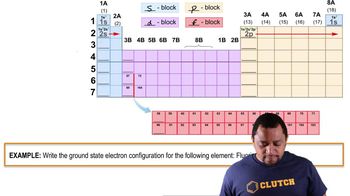
Electron Configuration Example
Periodic Table
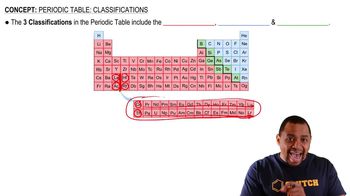
The periodic table organizes elements based on their atomic number and electron configurations, revealing periodic trends in properties. Elements in the same group often exhibit similar chemical behaviors due to their similar valence electron configurations. Understanding the periodic table is essential for identifying elements based on their electron configurations, as it provides context for their placement and characteristics.
추천 영상:
가이드 코스
Periodic Table Classifications
Valence Electrons
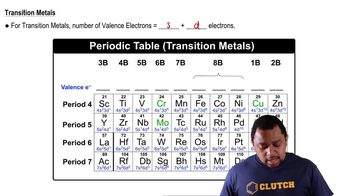
Valence electrons are the electrons in the outermost shell of an atom and are crucial for determining an element's reactivity and bonding behavior. In the given electron configuration, the valence electrons are found in the 4s and 4p orbitals. Knowing the number of valence electrons helps predict how an atom will interact with others, which is fundamental in understanding chemical reactions and compound formation.
추천 영상:
가이드 코스
Transition Metals Valence Electrons
관련 실천
교과서 질문
902
views
교과서 질문
Write the symbol, give the ground-state electron configuration, and draw an orbital-filling diagram for each of the following atoms. Use the abbreviation of the preceding noble gas to represent the inner-shell electrons. (a) The heaviest alkaline earth metal
727
views
교과서 질문
Write the symbol, give the ground-state electron configuration, and draw an orbital-filling diagram for each of the following atoms. Use the abbreviation of the preceding noble gas to represent the inner-shell electrons.
(c) The heaviest actinide metal
820
views
교과서 질문
How many unpaired electrons are present in each of the following ground-state atoms?
(a) O
(b) Si
(c) K
(d) As
1300
views
